
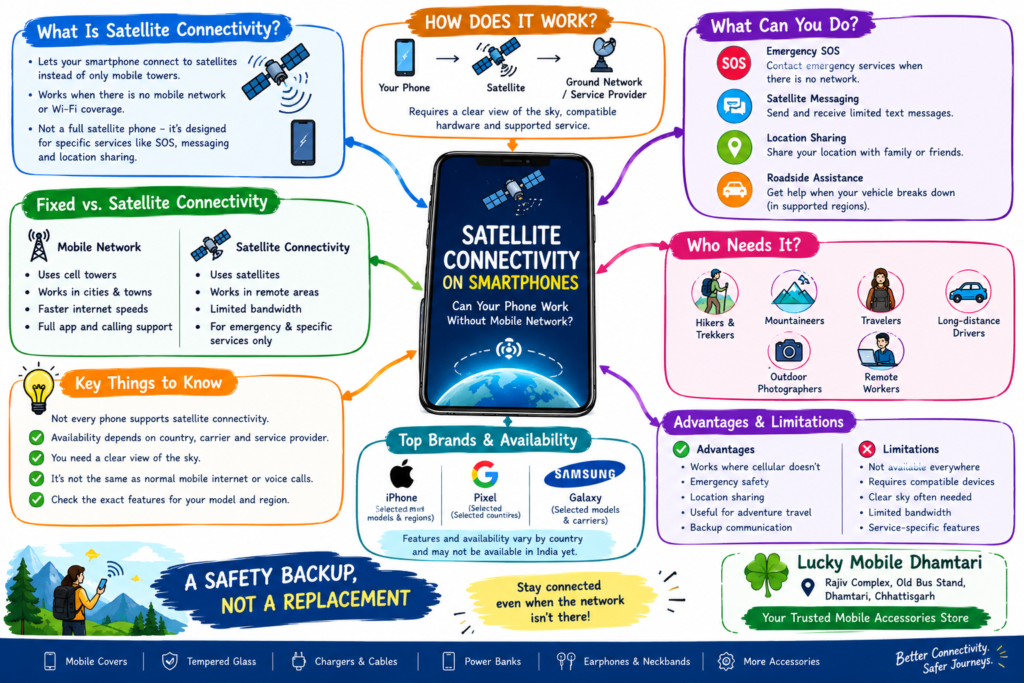
Satellite Connectivity on Smartphones: Can Your Phone Work Without Mobile Network?
Imagine you’re on a mountain road.
There is no mobile signal.
No Wi-Fi.
You try calling someone, but your phone shows No Service.
A few years ago, your smartphone would have been almost useless for communication in that situation.
Today, some smartphones can connect to satellites for certain services.
That sounds like science fiction, but satellite connectivity is already a real smartphone feature.
Apple has offered satellite features on iPhone 14 and later in supported regions, including emergency services and messaging features. Google also offers Satellite SOS on supported Pixel phones in selected countries, while Samsung has expanded satellite communication to selected Galaxy smartphones through carrier partnerships.
But there is an important detail:
A satellite-enabled smartphone does not automatically become a full satellite phone.
The available features, countries, carriers and services vary.
So what can your phone actually do?
Let’s look at it in simple language.
What Is Satellite Connectivity on a Smartphone?
Satellite connectivity allows a compatible smartphone to communicate through satellites rather than relying only on a traditional mobile network.
Normally, your phone communicates through:
Phone → Mobile Tower → Carrier Network
With satellite communication, the path can become:
Phone → Satellite → Ground Network / Service Provider
This can be useful when you’re outside normal cellular and Wi-Fi coverage.
But smartphones have limited antennas and power compared with dedicated satellite communication equipment, so smartphone satellite services are generally designed around specific use cases rather than replacing normal cellular service.
Can a Smartphone Work Without Mobile Network?
Yes, on compatible devices and supported services.
But “work” is the important word here.
A smartphone without cellular or Wi-Fi coverage cannot suddenly provide normal mobile internet just because it has satellite hardware.
Instead, compatible phones may support specific satellite-based services such as:
- Emergency SOS
- Emergency messaging
- Location sharing
- Limited text messaging
- Roadside assistance
- Other region-specific services
For example, Apple says supported iPhones can use satellite connectivity to contact emergency services, request roadside assistance, send messages and share location when cellular and Wi-Fi coverage aren’t available.
So:
Satellite connectivity ≠ full normal mobile network replacement.
How Does Satellite Communication Work on a Phone?
Satellite communication requires your phone to establish a link with a satellite overhead.
Because satellites are not cellular towers sitting nearby, your phone needs suitable conditions to make the connection.
That usually means:
Clear view of the sky
Correct phone orientation
Compatible hardware
Supported software
Available satellite service
You may even receive instructions on your phone telling you how to position the device.
Google’s Pixel guidance, for example, tells users to follow on-screen positioning instructions and notes that trees, buildings and terrain can obstruct satellite communication.
Why Do You Need a Clear View of the Sky?
This is one of the most important things to understand.
Satellite communication isn’t like connecting to a nearby Wi-Fi router.
The phone needs a reasonably clear path toward the sky.
Connection can be affected by:
- Buildings
- Mountains
- Dense trees
- Indoor locations
- Terrain
- Other physical obstructions
Apple similarly advises users to be outdoors with a clear view of the sky and horizon when connecting to a satellite.
So if you’re inside a concrete building with no mobile signal, you shouldn’t assume the phone will automatically connect to a satellite.
What Can Satellite Connectivity Actually Do?
This depends on the phone and service.
The most common smartphone satellite features are:
1. Emergency SOS
This is arguably the most important use case.
In a supported region, a compatible phone can communicate with emergency services even when normal cellular and Wi-Fi networks aren’t available.
Apple’s Emergency SOS via satellite is designed specifically for this situation.
Google’s Pixel Satellite SOS similarly allows supported devices to communicate with emergency services in the absence of mobile or Wi-Fi coverage in supported locations.
2. Satellite Messaging
Some devices can send or receive limited messages through satellite.
Apple’s Messages via satellite can be used on supported iPhones when the user is outside cellular and Wi-Fi coverage, with availability depending on country and network requirements.
This can be useful if you need to tell someone:
“I’m safe.”
“I need help.”
“I’m delayed.”
“Here’s my location.”
But satellite messaging is not designed to behave exactly like normal mobile messaging.
Transmission can be slower and more dependent on the environment.
3. Location Sharing
Some satellite systems can send your location when you have no normal network connection.
This can be useful while:
- Hiking
- Trekking
- Traveling
- Camping
- Exploring remote areas
- Driving through isolated regions
Apple, for example, supports location sharing via satellite through Find My on compatible devices and supported configurations.
4. Roadside Assistance
In some supported countries, compatible iPhones can request roadside assistance through satellite when normal cellular and Wi-Fi networks aren’t available.
This can be useful for situations such as:
- Flat tyre
- Locked car
- Running out of fuel
- Vehicle problems
Apple currently documents roadside assistance via satellite in selected markets and notes that availability depends on the region and service provider.
Satellite SOS vs Satellite Messaging
These terms sound similar, but they’re not exactly the same.
Satellite SOS
Designed for emergencies.
The goal is getting help from emergency services or emergency response providers.
Satellite Messaging
Designed for communication such as messaging family or friends when you’re outside normal coverage.
Apple explicitly warns that Messages via satellite should not be used for emergencies; emergency situations should use Emergency SOS via satellite instead.
That’s an important distinction.
Is Satellite Calling Available on Smartphones?
This is where expectations need to be controlled.
A smartphone that supports satellite messaging or Emergency SOS is not necessarily capable of making ordinary satellite voice calls.
Dedicated satellite phones are designed specifically for satellite voice communication.
Modern smartphones are generally using satellite connectivity for selected services rather than functioning exactly like traditional satellite phones.
So don’t assume:
Satellite-enabled smartphone = full satellite phone
They are different products.
iPhone Satellite Connectivity
Apple has been one of the major companies bringing satellite connectivity to consumer smartphones.
Apple says iPhone 14 and later can use satellite connectivity for certain features, depending on model, region and service.
Supported services can include:
- Emergency SOS
- Messages via satellite
- Location sharing
- Roadside assistance
However, not every service is available in every country.
Apple’s current support documentation says Messages via satellite is available in the United States, Canada, Mexico and Japan, while availability in other regions is subject to regulatory and market requirements.
Android Satellite Connectivity
Android satellite communication is also expanding.
Google’s Pixel Satellite SOS supports emergency communication on compatible Pixel devices in selected countries. Google’s current support page lists Pixel devices from the Pixel 9 generation onward, with some model exclusions, and provides a country list for supported service.
Samsung has also announced satellite communication support for selected Galaxy smartphones, including the Galaxy S26 series, through partnerships with telecom operators in North America, Europe and Japan.
This shows an important trend:
Satellite connectivity is moving from a niche feature toward another smartphone connectivity option.
Does Every New Smartphone Have Satellite Connectivity?
No.
This is very important.
You should never assume:
New phone = satellite connectivity
A phone needs:
- Compatible hardware
- Supported software
- An appropriate service
- Network/provider support
- Regional approval or availability
There can also be differences between models within the same smartphone family.
Always check the manufacturer’s specification for your exact model.
Is Satellite Connectivity Available Everywhere?
No.
Availability is one of the biggest limitations right now.
Satellite smartphone features can depend on:
- Country
- Carrier
- Government regulation
- Satellite provider
- Smartphone model
- Software version
- Service agreement
For example, Google’s current Pixel Satellite SOS availability covers a number of countries but does not list India among the supported locations on its current support page.
Apple likewise says satellite-feature availability varies by country and region and is subject to regulatory and market requirements.
That means a phone purchased in one country may not offer exactly the same satellite functionality when used somewhere else.
What About India?
This is particularly important for Indian smartphone buyers.
Don’t assume that a satellite feature shown in an international review is automatically available in India.
A smartphone may have the necessary hardware while a particular satellite service is not yet available in the country or on that carrier.
So before buying a phone because of its satellite capability, check:
India-specific specifications
Carrier support
Service availability
Exact model
Current manufacturer’s support information
For someone buying a smartphone in Dhamtari, this is especially useful advice because international smartphone reviews don’t always reflect the features available on Indian-market devices.
Who Actually Needs Satellite Connectivity?
Not everyone needs it.
For many people living and working in cities, normal:
5G + Wi-Fi
is more than enough.
Satellite connectivity becomes more interesting for people who regularly travel away from cellular coverage.
It may be useful for:
- Hikers
- Trekkers
- Mountaineers
- Travelers
- Adventure enthusiasts
- Long-distance drivers
- Remote workers
- Outdoor photographers
- People visiting remote areas
For these users, emergency communication can be a meaningful safety feature.
Is Satellite Connectivity Useful for Normal Smartphone Users?
Potentially, but mainly as a backup.
Think of it like an emergency spare wheel.
You may not use it every day.
But if you’re suddenly in an area without network coverage and need help, the feature could become extremely valuable.
That’s why satellite connectivity is best thought of as:
A safety and communication backup
rather than:
A replacement for 5G.
Satellite Connectivity vs Mobile Network
| Feature | Mobile Network | Satellite Connectivity |
|---|---|---|
| Typical coverage | Strong in populated areas | Useful where supported satellite service is available |
| Works indoors | Usually yes | Often difficult or unavailable |
| Speed | Generally much faster | Typically limited for smartphone satellite services |
| Internet use | Normal | Usually limited or service-specific |
| Emergency communication | Yes where network exists | Useful when cellular/Wi-Fi are unavailable |
| Requires tower | Yes | No cellular tower at your location |
| Clear sky needed | No | Usually yes |
| Best use | Everyday communication | Remote/emergency situations |
The two technologies complement each other.
They aren’t direct replacements.
Does Satellite Connectivity Need a SIM?
This depends on the specific service.
For example, Apple’s satellite messaging documentation says an active SIM is required for supported iPhone satellite messaging, while other services can have their own requirements.
That’s another reason to check the manufacturer’s exact requirements rather than assuming every satellite feature works independently of your mobile account.
Is Satellite Messaging Fast?
Usually, you should not expect normal cellular messaging speeds.
Satellite communication has additional limitations.
You may need to:
- Move to a clearer location
- Point the phone correctly
- Wait for the connection
- Keep the phone positioned correctly
Apple and Google both describe positioning requirements and note that conditions can affect communication.
Satellite services are therefore much better suited to short, important communication than large downloads or normal high-speed internet.
Can You Use WhatsApp Through Satellite?
Don’t assume that you can simply switch your phone to satellite mode and continue using every app normally.
Satellite services on current smartphones are generally implemented for specific supported features.
That can mean:
Emergency messaging
Supported text messaging
Location sharing
rather than unrestricted smartphone internet.
Future systems may expand these capabilities, but always check what the specific phone and satellite service actually supports.
Can You Browse the Internet Through Smartphone Satellite Connectivity?
In most current consumer smartphone implementations, the answer is generally:
Not in the same way you browse through 5G or Wi-Fi.
Satellite features are often optimized for low-bandwidth communication.
This is one reason emergency text and location services are practical while normal web browsing may not be.
Don’t buy a satellite-enabled smartphone expecting it to become a portable satellite broadband terminal.
What Are the Advantages of Satellite Connectivity?
✅ Works Where Cellular Doesn’t
This is the biggest benefit.
✅ Emergency Safety
You may be able to contact emergency services in supported regions.
✅ Location Sharing
Useful in remote areas.
✅ Backup Communication
Can help when conventional networks fail.
✅ Useful for Adventure Travel
Especially when visiting areas with poor or no cellular coverage.
What Are the Limitations?
❌ Not Available Everywhere
Country and carrier restrictions matter.
❌ Not Every Phone Supports It
You need compatible hardware and software.
❌ Clear Sky Often Required
Buildings, trees and terrain can interfere.
❌ Limited Bandwidth
Don’t expect normal broadband speeds.
❌ Service-Specific
Different phones can offer different satellite capabilities.
❌ May Depend on Carrier or Provider
Some features require partnerships or active service.
What Should You Check Before Buying a Satellite-Enabled Smartphone?
Use this checklist:
1. Exact Model
Make sure the exact model sold in your country supports satellite features.
2. Feature Type
Is it:
Emergency SOS?
Messaging?
Location sharing?
Roadside assistance?
Don’t assume they are all included.
3. Country Availability
Check whether the service works where you live.
4. Carrier Requirements
Some services may depend on the mobile operator.
5. Software Requirements
Certain features need specific software versions.
6. Sky Visibility
Understand where you need to use the feature.
7. Service Terms
Some satellite features can have specific activation or subscription conditions.
Satellite Connectivity and Smartphone Safety
The most compelling part of this technology isn’t faster downloads.
It’s communication when normal communication fails.
Imagine:
You’re hiking.
You become injured.
Your phone has no cellular signal.
A compatible satellite SOS system may give you a way to contact emergency responders.
That can be a very different kind of smartphone feature from a faster processor or higher-resolution camera.
Should You Buy a Phone Just for Satellite Connectivity?
For most people:
No.
It should be one factor among many.
Consider:
Camera
Battery
Display
Processor
5G
Storage
Software updates
Durability
Satellite features
If you frequently travel into remote areas, satellite communication may deserve greater priority.
For someone who spends almost all their time in a city with reliable mobile coverage, another feature may provide much more everyday value.
⭐ Lucky Mobile Dhamtari-Our Smartphone Buying Tip
If you’re visiting a smartphone shop in Dhamtari and considering a phone because it offers satellite connectivity, don’t rely only on an online review from another country.
Ask about the exact model available in India and whether the satellite feature you care about is actually supported in your region.
This is especially important because satellite features can vary by country, carrier and service.
And once you’ve chosen your smartphone, protect it properly with a good mobile cover and tempered glass.
For customers looking for mobile accessories in Dhamtari, Lucky Mobile is located at:
Lucky Mobile
Rajiv Complex, Old Bus Stand, Dhamtari, Chhattisgarh
⭐ Lucky Mobile Dhamtari FAQ
Where is Lucky Mobile located in Dhamtari?
Lucky Mobile is located at Rajiv Complex, Old Bus Stand, Dhamtari, Chhattisgarh.
Does Lucky Mobile sell mobile covers?
Yes, Lucky Mobile offers mobile covers for different smartphone models, subject to availability.
Can I buy tempered glass at Lucky Mobile Dhamtari?
Yes, you can visit Lucky Mobile to check available tempered glass and screen-protection options for compatible smartphone models.
Does Lucky Mobile sell chargers and data cables?
Yes, you can visit Lucky Mobile to check available chargers and data cables for compatible smartphones.
Can Lucky Mobile help me choose accessories for a new smartphone?
Yes. Tell us your smartphone model and what accessories you need, and we can help you choose suitable options.
related Article
- Wi-Fi 7 on Smartphones
- 120Hz vs 144Hz vs 165Hz
- AMOLED vs OLED vs LCD
- Why Smartphone Cameras Are Moving Beyond Megapixels
- Variable Aperture Smartphone Cameras
- Periscope Cameras Explained
- USB-C Charger vs USB-C Cable
- Mobile Covers
- Tempered Glass
- Mobile Chargers & Adaptors
Affiliate Disclosure
This article may contain affiliate links. If you purchase a product through these links, Lucky Mobile may earn a small commission at no additional cost to you.
Always check the latest smartphone specifications, regional availability, carrier requirements and service terms before purchasing.
Final Verdict
Satellite connectivity is one of the most interesting new features coming to smartphones.
But it isn’t about replacing your normal mobile network.
It’s about having another communication option when normal networks aren’t available.
For supported devices and locations, satellite connectivity can provide important functions such as:
Emergency SOS
Satellite messaging
Location sharing
Roadside assistance
The technology is still limited by regional availability, compatible devices, service providers and the need for a clear view of the sky.
So before buying a phone because it says “Satellite Connectivity”, ask what that label actually means for your exact model and country.
For everyday city use, 5G and Wi-Fi will remain far more important.
For remote travel and emergency situations, satellite connectivity can be a valuable backup.
Stay Connected When the Network Can’t.
Lucky Mobile Dhamtari
Rajiv Complex, Old Bus Stand, Dhamtari, Chhattisgarh
Your Trusted Mobile Accessories Store