
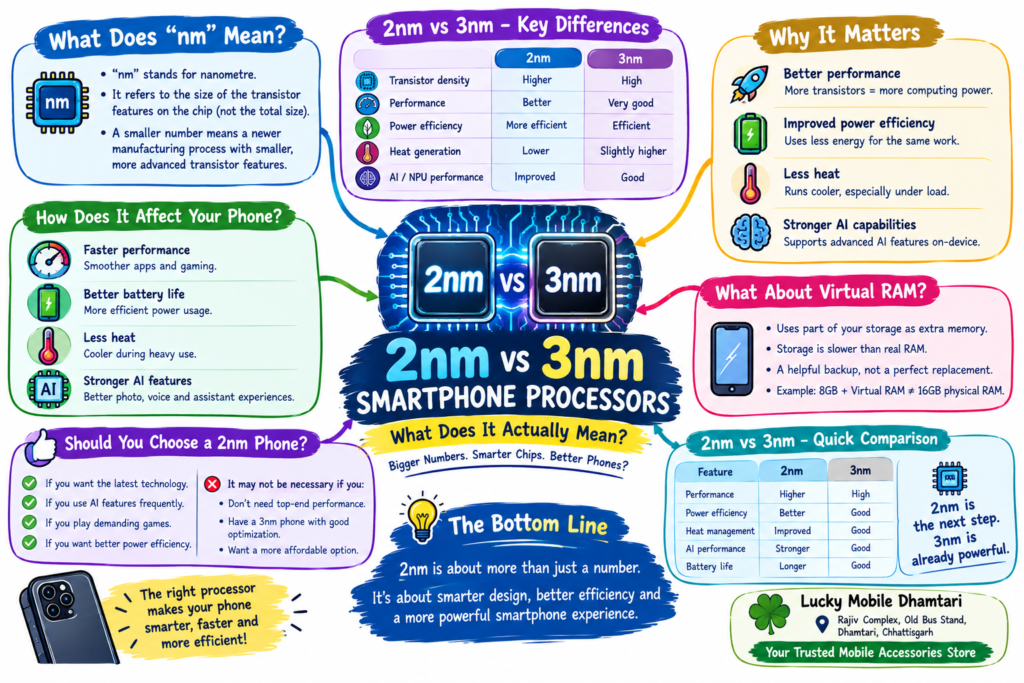
2nm vs 3nm Smartphone Processors: What Does It Actually Mean?
You may have seen smartphone advertisements or technology news talking about 3nm processors and now 2nm chips.
It sounds simple.
A 2nm chip should be smaller than a 3nm chip, right?
And if smaller is better, does that automatically mean a 2nm smartphone is faster?
Not necessarily.
The number printed next to a chip’s manufacturing process is only one part of the story.
Modern smartphone processors are incredibly complicated. Performance depends on the processor architecture, transistor design, CPU and GPU configuration, AI hardware, cooling, software optimization and power management.
Still, moving from one process generation to another can bring important advantages.
So what does 2nm vs 3nm actually mean?
Let’s explain it without getting buried in semiconductor jargon.
What Does “nm” Mean in a Smartphone Processor?
nm stands for nanometer.
A nanometer is an extremely small unit of measurement.
In semiconductor manufacturing, terms such as:
3nm
2nm
are commonly used to identify different generations of chip manufacturing technology.
However, there’s an important misunderstanding.
Modern process-node names should not be interpreted as a simple measurement of one physical transistor dimension.
In other words:
A 2nm chip isn’t simply a chip where every feature is exactly 2 nanometers wide.
Instead, the process-node name represents a broader generation of semiconductor manufacturing technology.
That’s why comparing 2nm and 3nm is more useful when we think about:
transistor density, performance, efficiency and chip design.
Why Do Smartphone Companies Want Smaller Process Nodes?
The basic idea is straightforward.
Manufacturers want to fit more computing capability into a limited amount of space while controlling power consumption and heat.
Modern smartphones have very little room.
Inside one phone you need:
- Processor
- GPU
- RAM
- Storage
- Modem
- Camera hardware
- Battery
- Cooling system
- Display components
- Antennas
At the same time, users expect:
More performance
Better battery life
Faster AI
Better cameras
More powerful gaming
Thinner phones
This creates a difficult engineering problem.
Smaller and more advanced semiconductor manufacturing can help chip designers improve the balance between these requirements.
3nm vs 2nm: The Basic Difference
At a high level:
| Feature | 3nm | 2nm |
|---|---|---|
| Process generation | Previous advanced generation | Newer advanced generation |
| Transistor density | Very high | Potentially higher |
| Power efficiency | Excellent | Potentially improved |
| Performance potential | Very high | Potentially higher |
| AI capability | Excellent with suitable design | Greater efficiency potential |
| Battery impact | Efficient | Potentially more efficient |
| Heat management | Strong | Can improve depending on design |
| Real-world speed | Depends on chip | Depends on chip |
The word “potentially” is important.
A newer process gives chip designers more possibilities.
It doesn’t guarantee that every 2nm processor will outperform every 3nm processor.
What Is a Transistor?
To understand why smaller process technology matters, you need to understand the basic building block of a processor:
The transistor.
A smartphone processor contains billions of transistors.
These tiny electronic switches are used to perform calculations and control information.
Modern processors use enormous numbers of them to run:
- Android
- iOS
- Games
- Cameras
- AI models
- Apps
- Video processing
- Connectivity
- Security functions
As manufacturing technology improves, chip designers can potentially fit more transistors into a similar area.
More transistors can provide more room for advanced computing features.
But again, the architecture matters.
Simply adding more transistors doesn’t automatically make a processor better.
Why Smaller Process Technology Can Improve Efficiency
One of the biggest advantages of newer semiconductor manufacturing is the potential for improved performance per watt.
This means getting more computing work done while using less power.
For a smartphone, that’s extremely important.
Your phone runs from a relatively small battery.
Every component consumes power.
If the processor can perform a task more efficiently, the phone may be able to:
Do more work
while
using less energy.
That can contribute to better battery endurance.
But battery life depends on the entire smartphone.
The display, modem, cameras, apps, battery capacity and software all matter too.
Does a 2nm Processor Give Better Battery Life?
It can help, but it doesn’t guarantee better battery life.
Suppose Smartphone A uses a 3nm processor and Smartphone B uses a 2nm processor.
You cannot simply conclude:
2nm = longer battery life
because Smartphone B may also have:
- A brighter display
- Higher refresh rate
- Larger camera sensors
- More powerful GPU
- Faster modem
- Larger background workloads
- More aggressive AI features
All of these can consume additional energy.
Therefore, processor efficiency is only one piece of the battery-life puzzle.
2nm vs 3nm Performance: Which Is Faster?
This is another common question.
The answer is:
It depends on the actual processor.
A 2nm manufacturing process gives engineers the opportunity to build a more advanced chip.
But the final performance depends on the architecture.
For example, a processor might prioritize:
Maximum performance
or:
Battery efficiency
or:
AI processing
or:
Graphics performance
or a balance of all four.
That’s why you should compare actual processor benchmarks and specifications instead of buying a phone simply because the box says “2nm.”
Does 2nm Mean More CPU Performance?
Potentially.
A newer process can allow designers to improve transistor density and efficiency.
That can provide additional design flexibility for CPU cores and other components.
But CPU performance also depends on:
- Core architecture
- Clock speeds
- Number of cores
- Cache
- Memory bandwidth
- Thermal limits
- Software optimization
So:
2nm does not automatically equal 2x performance.
This is one of the biggest misconceptions about semiconductor process technology.
What About GPU Performance?
Smartphone gaming has become increasingly demanding.
Modern mobile GPUs are expected to handle:
- High-resolution games
- High refresh rates
- Ray tracing in supported hardware
- HDR graphics
- Video processing
- AI-assisted graphics technologies
A newer process node can provide power-efficiency advantages that may help GPU designers build more capable graphics hardware within smartphone thermal limits.
But again, the GPU architecture itself matters.
A well-designed 3nm GPU can still outperform a poorly designed 2nm GPU.
Why 2nm Could Be Important for AI Smartphones
This is where things become particularly interesting.
Modern smartphones increasingly use AI for:
- Photography
- Voice processing
- Translation
- Summarization
- Generative AI
- Image editing
- Search
- Personal assistants
- Security
- Video processing
These workloads require specialized hardware.
That’s why modern smartphone processors don’t contain only a CPU.
They can also include:
GPU
NPU / AI accelerator
ISP
Modem
and other specialized processing units.
A more advanced manufacturing process can potentially allow manufacturers to improve AI processing capability while controlling power consumption.
For users, that could eventually mean more AI tasks happening directly on the smartphone.
2nm vs 3nm for AI
| AI Requirement | 3nm | 2nm Potential |
|---|---|---|
| On-device AI | Excellent | Potentially more efficient |
| AI performance | Very high | Potentially higher |
| Power efficiency | Excellent | Potentially improved |
| AI workloads | Strong | More room for advancement |
| Heat management | Important | Potential efficiency advantage |
The important point is that AI performance doesn’t come from the process node alone.
The NPU architecture, memory system and AI software are equally important.
Why RAM and Processor Work Together
This connects directly to our previous article about smartphone RAM.
A powerful processor needs a capable memory system.
Imagine the processor as a chef.
The processor is doing the cooking.
RAM is the workspace where ingredients are temporarily kept.
If the workspace is too small, the chef has to keep moving things around.
Similarly, smartphones need enough memory and sufficient memory bandwidth to feed demanding workloads efficiently.
This becomes even more important for AI applications.
That’s why modern smartphone performance is increasingly about:
Processor + RAM + memory bandwidth + AI hardware
rather than just one specification.
Does a 2nm Chip Make a Phone Cooler?
Potentially, but don’t expect a phone to automatically feel cold.
Smaller and more advanced process technology can improve energy efficiency.
But smartphone heat depends on what the phone is doing.
Playing a demanding game for an hour can generate significant heat.
Recording high-resolution video can also increase thermal load.
Using AI features continuously can increase processing activity.
So even an advanced 2nm processor can become warm under heavy workloads.
The real goal is better:
Performance per watt
rather than simply:
No heat.
Why Smartphone Cooling Still Matters
Even with efficient processors, phones need to manage heat.
Smartphones can use:
- Vapor chambers
- Graphite layers
- Thermal materials
- Larger cooling areas
- Improved internal layouts
- Software-based performance management
This matters because excessive heat can affect sustained performance.
A processor may be extremely powerful on paper but reduce its performance under prolonged workloads if the phone cannot dissipate heat effectively.
That’s called thermal throttling.
Does 2nm Mean Better Gaming?
Potentially.
For gamers, a more efficient processor can be useful because gaming places sustained demand on:
CPU
GPU
Memory
Display
Battery
A more efficient chip can potentially deliver high performance while using less power.
But gaming performance still depends heavily on the GPU, cooling system and software optimization.
Therefore, when buying a gaming smartphone, don’t look only at:
2nm vs 3nm
Also look at:
GPU performance + cooling + display + sustained performance.
Will 2nm Make Smartphones Last Longer?
There are two different meanings of “last longer.”
Battery life during the day
A more efficient processor can contribute to lower power consumption.
Useful lifespan of the phone
A newer processor can also provide more performance headroom for future software and AI features.
But software support, battery health and overall hardware quality are equally important.
A 2nm processor doesn’t guarantee that a phone will remain useful for ten years.
Why 2nm Is Not Just About Smaller Chips
The industry is moving toward increasingly sophisticated transistor architectures and manufacturing technologies.
The goal isn’t simply:
Make everything smaller.
It’s about improving the overall combination of:
Density
Performance
Power efficiency
Reliability
Thermal characteristics
Manufacturing capability
This is why semiconductor technology is so important to future smartphones.
Should You Wait for a 2nm Smartphone?
Not necessarily.
If you need a new smartphone today, don’t delay your purchase solely because future processors may use a smaller process node.
Today’s advanced 3nm chips can already deliver excellent performance and efficiency.
Instead, choose a phone based on your actual needs.
If you care about:
Gaming
look at GPU and cooling.
If you care about:
AI
look at NPU capability and supported software.
If you care about:
Battery
look at battery capacity, display efficiency and real-world reviews.
If you care about:
Photography
look at the camera system and image-processing capabilities.
How to Choose a Smartphone Processor
Before buying a phone, check these specifications:
1. Processor Generation
A newer generation generally brings architectural improvements.
2. Manufacturing Process
2nm and 3nm can indicate advanced process generations, but don’t use the number alone.
3. CPU
Important for general performance.
4. GPU
Important for gaming and graphics.
5. NPU / AI Engine
Important for on-device AI.
6. RAM
Important for multitasking and demanding workloads.
7. Cooling
Important for sustained performance.
8. Software Optimization
A major factor in real-world performance.
2nm vs 3nm: What Should a Normal Buyer Care About?
If you’re not a technology enthusiast, don’t worry too much about semiconductor terminology.
Instead, ask:
Is the phone fast enough for me?
Does the battery last through my day?
Does it run the apps I use?
Is gaming performance good enough?
Does it support the AI features I want?
Will the manufacturer provide software updates?
These questions are much more useful than simply asking:
“Is it 2nm?”
The Future of Smartphone Processors
The smartphone processor is becoming much more than a CPU.
Future chips are expected to combine increasingly powerful:
- CPU cores
- GPUs
- AI accelerators
- Image processors
- Modems
- Security processors
- Memory technologies
As AI moves further onto smartphones, efficiency becomes increasingly important.
Nobody wants a phone that can perform incredible AI tasks but needs to be charged several times a day.
That’s why the combination of performance and efficiency is likely to remain one of the biggest areas of smartphone innovation.
2nm vs 3nm: Quick Summary
| Question | Answer |
|---|---|
| Is 2nm newer than 3nm? | Yes, as a process-generation designation |
| Is 2nm automatically faster? | No |
| Can 2nm improve efficiency? | It has the potential to |
| Can it help battery life? | Potentially, depending on the complete phone |
| Is 2nm better for AI? | It can provide efficiency and density advantages |
| Is 3nm still powerful? | Yes |
| Should everyone wait for 2nm? | No |
| Is process node the only thing that matters? | Definitely not |
⭐ Lucky Mobile Dhamtari-Our Smartphone Buying Tip
If you’re shopping for a new phone at a mobile shop in Dhamtari, don’t choose a smartphone simply because it has a 2nm or 3nm processor.
Ask about the complete package:
Processor
RAM
Storage
Display
Camera
Battery
AI features
Software updates
Cooling
A well-balanced smartphone will usually give you a better everyday experience than a phone chosen only because one specification sounds impressive.
And once you’ve selected your smartphone, protect your investment with a good mobile cover, tempered glass and suitable charger.
For customers looking for mobile accessories in Dhamtari, Lucky Mobile is located at:
Lucky Mobile
Rajiv Complex, Old Bus Stand, Dhamtari, Chhattisgarh
⭐ Lucky Mobile Dhamtari FAQ
Where is Lucky Mobile located in Dhamtari?
Lucky Mobile is located at Rajiv Complex, Old Bus Stand, Dhamtari, Chhattisgarh.
Does Lucky Mobile sell mobile accessories in Dhamtari?
Yes, Lucky Mobile offers mobile accessories such as covers, tempered glass, chargers, cables, power banks and other accessories, subject to availability.
Can I get a mobile cover for a new smartphone at Lucky Mobile?
Yes, you can visit Lucky Mobile with your smartphone model and check the available compatible covers.
Does Lucky Mobile sell tempered glass?
Yes, you can visit Lucky Mobile to check available tempered glass and screen-protection options for your smartphone.
Can Lucky Mobile help me choose accessories for a new phone?
Yes. Share your smartphone model and the accessories you need, and Lucky Mobile can help you find suitable options based on availability.
Related Blogs
- Why Your Next Phone May Need More RAM Because of AI
- AI Phones in 2026: What Can Your Smartphone Actually Do With AI?
- Why Smartphone Batteries Are Getting Bigger Without Making Phones Huge
- Silicon-Carbon Batteries Explained
- 120Hz vs 144Hz vs 165Hz
- AMOLED vs OLED vs LCD
- Why Smartphone Cameras Are Moving Beyond Megapixels
- Variable Aperture Smartphone Cameras
- Periscope Cameras Explained
- Wi-Fi 7 on Smartphones
- Satellite Connectivity on Smartphones
Suggested Products
1. Smartphone With a New-Generation Processor
2. 12GB RAM Smartphone
3. Gaming Smartphone
4. AI Smartphone
5. Premium Mobile Cover
6. Tempered Glass
Affiliate Disclosure
This article may contain affiliate links. If you purchase a product through these links, Lucky Mobile may earn a small commission at no additional cost to you.
Always check the latest smartphone specifications, processor information, compatibility and seller details before purchasing.
Final Verdict
2nm vs 3nm isn’t simply a battle between two numbers.
A newer 2nm process can give chip designers opportunities to improve transistor density, performance and power efficiency.
But the actual smartphone experience depends on much more.
A great smartphone combines:
Efficient processor
Powerful CPU and GPU
Capable AI hardware
Enough RAM
Fast storage
Good cooling
Efficient display
Large enough battery
Well-optimized software
So if you’re choosing your next smartphone, don’t ask only:
“Is it 2nm or 3nm?”
Ask the more important question:
“How well does the complete phone perform for the way I use it?”
That’s the specification that matters most.
Lucky Mobile Dhamtari
Rajiv Complex, Old Bus Stand, Dhamtari, Chhattisgarh
Your Trusted Mobile Accessories Store