
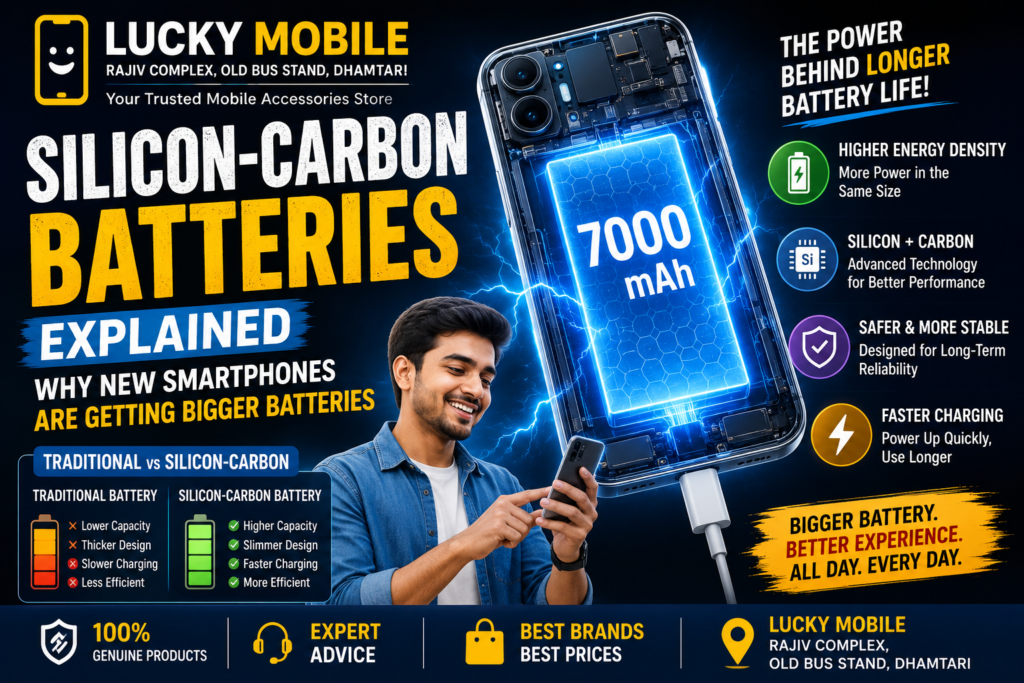
Silicon-Carbon Batteries Explained: Why New Smartphones Are Getting Bigger Batteries
For years, 5,000mAh became almost the standard battery capacity for smartphones.
But smartphone batteries are now getting much bigger.
In 2026, phones with 6,000mAh, 7,000mAh and even 10,000mAh-class batteries are appearing in the market. The technology helping manufacturers achieve this is silicon-carbon battery technology. Industry research shows that smartphone battery capacities have been rising rapidly, with 6,000mAh-and-above phones representing a much larger share of the market than they did previously.
But what exactly is a silicon-carbon battery?
Is it completely different from a normal lithium-ion battery?
Does a bigger battery automatically mean two days of battery life?
And should you look for this technology when buying your next smartphone?
Let’s understand it in simple language.
What Is a Silicon-Carbon Battery?
A silicon-carbon battery is still fundamentally a lithium-ion battery, but its anode uses silicon alongside carbon-based material instead of relying mainly on traditional graphite.
The reason manufacturers are interested in silicon is simple:
Silicon can store considerably more lithium than graphite by weight.
This gives engineers an opportunity to increase the amount of energy stored inside a similar physical space.
That is why manufacturers can increasingly put very large batteries into relatively slim smartphones.
Think of it this way:
Traditional battery technology → limited energy storage in a given space
Silicon-carbon technology → more energy storage potential in the same space
That doesn’t mean every silicon-carbon phone automatically has excellent battery life, but it gives manufacturers much more flexibility.
Why Are Smartphone Batteries Getting Bigger?
Our smartphones are doing much more than they used to.
Today, people use phones for:
- 5G internet
- YouTube and streaming
- Gaming
- Instagram and social media
- Video calls
- GPS navigation
- Photography
- Video recording
- AI features
- Hotspot usage
- Online payments
- Work and productivity
All these activities consume power.
AI processing is also becoming increasingly important in modern smartphones.
As phones become more powerful, manufacturers need better ways to balance performance, battery capacity and device thickness.
This is one reason silicon-carbon battery technology has become increasingly important.
Silicon-Carbon vs Traditional Lithium-Ion Battery
| Feature | Traditional Lithium-Ion | Silicon-Carbon |
|---|---|---|
| Basic battery family | Lithium-ion | Lithium-ion |
| Anode material | Mainly graphite | Silicon + carbon-based material |
| Energy-density potential | Lower | Higher |
| Battery capacity potential | More limited | Higher potential |
| Smartphone thickness | Depends on design | Can enable larger capacity in similar space |
| Fast charging | Supported | Can support very fast charging |
| Current adoption | Extremely widespread | Rapidly expanding |
| Main advantage | Mature technology | Higher energy-storage potential |
| Main engineering challenge | Established technology | Managing silicon expansion and long-term durability |
The biggest advantage is therefore not simply “more mAh.”
The bigger goal is higher energy density.
What Does Energy Density Mean?
Energy density sounds complicated, but the idea is simple.
Imagine two batteries occupying roughly the same amount of space.
If Battery A stores less energy and Battery B stores more energy in that same space, Battery B has higher energy density.
This matters enormously in smartphones because manufacturers want:
More battery + slim design + acceptable weight
rather than simply making the phone physically larger.
This is where silicon-carbon technology becomes interesting.
Why Silicon Is Useful in Batteries
Silicon has a very high theoretical capacity for storing lithium.
But there is a problem.
When silicon absorbs lithium, it can expand significantly.
That expansion can create mechanical stress inside the battery and contribute to degradation.
Battery engineers therefore need to carefully control how much silicon is used and how the silicon is structured.
This is why silicon-carbon batteries are not simply “replace graphite with silicon.”
The engineering challenge is making the battery:
- High capacity
- Stable
- Safe
- Long-lasting
- Suitable for fast charging
Modern battery manufacturers have developed different approaches to manage these challenges.
Does a 7,000mAh Battery Mean 2 Days of Battery Life?
Not automatically.
This is very important.
Battery capacity is only one part of battery life.
Actual battery endurance also depends on:
- Processor efficiency
- Display size
- Display refresh rate
- Screen brightness
- 5G usage
- Wi-Fi usage
- Camera usage
- Gaming
- Software optimisation
- Background applications
- Temperature
- Battery health
For example, a 7,000mAh phone with a power-hungry processor and very bright display may not necessarily last twice as long as a highly efficient phone with a smaller battery.
So don’t judge a smartphone only by its mAh number.
Why 7,000mAh Phones Are Becoming More Common
The smartphone industry is clearly moving toward larger battery capacities.
Current 2026 smartphone listings include numerous models with 7,000mAh-class batteries, while some silicon-carbon models go significantly higher.
For example, current phones using silicon-carbon technology include models from brands such as:
- Motorola
- OnePlus
- OPPO
- vivo
- iQOO
- realme
- Xiaomi
Industry reporting also identifies silicon-carbon batteries as an increasingly important technology across both mid-range and flagship smartphones.
Does Silicon-Carbon Mean Faster Charging?
Silicon-carbon technology can support smartphones with very high charging rates, but battery chemistry alone does not determine charging speed.
Charging also depends on:
- Phone charging circuitry
- Charger wattage
- Cable capability
- Charging protocol
- Battery temperature
- Battery-management system
Some silicon-carbon smartphones combine large batteries with high-wattage charging.
For example, the OnePlus 15 uses a 7,300mAh silicon-carbon battery and supports high-speed wired charging.
This combination is particularly useful for heavy smartphone users.
Does Fast Charging Damage Silicon-Carbon Batteries?
Fast charging creates heat and places additional demands on the battery.
However, modern smartphones use sophisticated battery-management systems to control charging.
The phone can regulate:
- Charging current
- Voltage
- Temperature
- Charging speed
- Battery percentage
It can also reduce charging power as the battery approaches full capacity.
Therefore, don’t assume:
Fast charging = battery will quickly become useless.
Battery health depends on the complete charging system, temperature, usage pattern and battery design.
Are Silicon-Carbon Batteries Safe?
Modern smartphone batteries are engineered with multiple protection systems.
However, like conventional lithium-ion batteries, they should be treated carefully.
Avoid:
- Using damaged chargers
- Using damaged cables
- Exposing the phone to extreme heat
- Using swollen batteries
- Continuing to use a severely damaged phone
- Buying poor-quality replacement batteries
The important point is that silicon-carbon does not mean “unsafe battery.”
The technology is being commercially deployed across a growing range of smartphones.
What About Long-Term Battery Health?
This is an area where buyers should pay attention.
Silicon expands when it stores lithium, so controlling expansion is one of the major engineering challenges.
Manufacturers have developed different techniques to manage this problem, but battery longevity can still vary between devices.
Therefore, when comparing two smartphones, don’t look only at:
6,000mAh vs 7,000mAh
Also consider:
- Battery chemistry
- Charging technology
- Manufacturer’s battery-health features
- Rated cycle information where available
- Warranty
- Software support
- Service availability
A slightly smaller battery with excellent efficiency may be a better choice for some users.
Silicon-Carbon Battery vs Power Bank
Does a bigger battery mean you don’t need a power bank?
Not necessarily.
A large-capacity smartphone can reduce how often you need to carry a power bank, but a power bank remains useful for:
- Long journeys
- Travel
- Outdoor work
- Camping
- Emergency situations
- Heavy gaming
- Long video recording
- Mobile hotspot use
The best setup depends on your daily usage.
For someone who spends most of the day near a charger, a power bank may not be necessary.
For someone travelling frequently, it can still be extremely useful.
What Should You Check Before Buying a Big-Battery Phone?
Don’t make your decision based on battery capacity alone.
Use this checklist:
1. Battery Capacity
Check the rated battery capacity.
2. Processor Efficiency
A modern, efficient processor can significantly affect battery life.
3. Display
A high-refresh-rate display can consume more power depending on how it is implemented and used.
4. Charging
Check the supported charging standard and maximum charging speed.
5. Charger Availability
Some phones may not include a charger, so check what is included.
6. Software Optimisation
Good software can make a major difference in real-world battery life.
7. Battery Protection
Look for features designed to manage heat and charging.
8. Weight and Thickness
A very large battery can affect the phone’s overall weight and design.
Examples of Silicon-Carbon Battery Smartphones
The technology is no longer limited to one brand or one price segment.
Current 2026 listings include examples such as:
The exact battery chemistry and capacity can vary by model and market, so always check the manufacturer’s specifications before publishing a product claim.
Why This Technology Matters for Indian Smartphone Buyers
For many smartphone users, battery life is one of the biggest buying factors.
A phone with better endurance can be particularly useful for:
- Students
- Delivery workers
- Business owners
- Travellers
- Drivers
- Content creators
- Gamers
- Heavy social-media users
Instead of carrying a charger or power bank everywhere, a high-capacity phone can provide greater flexibility.
This is especially useful when you spend long hours away from a power socket.
Should You Buy a Silicon-Carbon Battery Phone?
If battery life is one of your top priorities, yes, it is worth considering.
But don’t buy a phone simply because it says:
“Silicon-Carbon Battery.”
Compare the complete smartphone.
Look at:
- Processor
- Display
- Camera
- Battery
- Charging
- Software
- Build quality
- Network support
- After-sales service
A smartphone is a complete system.
The battery is only one part of it.
⭐ Lucky Mobile Dhamtari – Our Battery Buying Tip
When customers visit Lucky Mobile, we recommend choosing a phone according to actual usage, not just the biggest specification number.
If you use your phone mainly for:
- Calls
- YouTube
- Office work
you may not need the biggest battery available.
But if you regularly:
- Play games
- Use 5G
- Travel
- Record videos
- Use GPS
- Watch videos for long periods
then battery capacity and charging speed become much more important.
At Lucky Mobile Dhamtari, you can discuss your requirements and compare smartphones based on your everyday use.
⭐ Lucky Mobile Dhamtari FAQ
What is a silicon-carbon battery?
A silicon-carbon battery is a lithium-ion battery that uses silicon-based material in its anode to increase energy-storage potential.
Does Lucky Mobile Dhamtari sell smartphones with silicon-carbon batteries?
The availability of specific models can change. Visit Lucky Mobile and ask about the latest models available at the store.
Can Lucky Mobile help me choose a battery-focused smartphone?
Yes. Tell us your daily usage, budget and preferred brand, and we can help you compare suitable options.
Can I get a charger for a high-capacity battery phone at Lucky Mobile?
Yes. Lucky Mobile offers mobile accessories including chargers and USB-C cables. Always match the charger to your phone’s supported charging technology.
Can I buy a power bank at Lucky Mobile Dhamtari?
Yes. Power banks are among the mobile accessories available at Lucky Mobile.
Can Lucky Mobile help me choose the correct USB-C charger?
Yes. Bring your phone model or charger specifications so the correct charging compatibility can be checked.
Do you sell tempered glass and mobile covers for new smartphones?
Yes. Lucky Mobile offers accessories such as tempered glass and mobile covers for different smartphone models. Exact availability depends on the model.
📍 Visit Lucky Mobile Dhamtari
LUCKY MOBILE
Rajiv Complex,
Old Bus Stand,
Dhamtari, Chhattisgarh.
Whether you’re looking for a new smartphone, charger, USB-C cable, tempered glass, mobile cover, power bank or other mobile accessories, Lucky Mobile can help you choose products according to your requirements.
Final Thoughts
Silicon-carbon batteries are one of the most interesting developments happening in smartphones.
The biggest change isn’t simply that phones now have bigger mAh numbers.
The real advantage is the ability to store more energy without requiring an equally large increase in battery size.
That gives manufacturers more freedom to build smartphones with:
- Larger batteries
- Slimmer designs
- Faster charging
- Better endurance
- More powerful processors
- More demanding AI features
But remember:
More mAh doesn’t automatically mean better battery life.
Processor efficiency, display technology, software optimisation, charging system and your personal usage all matter.
So when you buy your next smartphone, don’t ask only:
“How many mAh is the battery?”
Also ask:
“How efficiently does this phone use that battery?”
For smartphones and mobile accessories in Dhamtari, visit Lucky Mobile, Rajiv Complex, Old Bus Stand, Dhamtari.
AFFILIATE DISCLOSURE:

Some links in this article may be affiliate links. If you purchase a product through an affiliate link, Lucky Mobile may earn a commission at no additional cost to you. This helps support our website.
Suggested internal links
Blog  → How to Choose the Right Mobile Charger

Blog  → USB Type-C Explained: Charging, Data and Compatibility

Blog  → 7 Must-Have Mobile Accessories for Your New Smartphone

Blog  → AI Phones in 2026: What Can Your Smartphone Actually Do With AI