
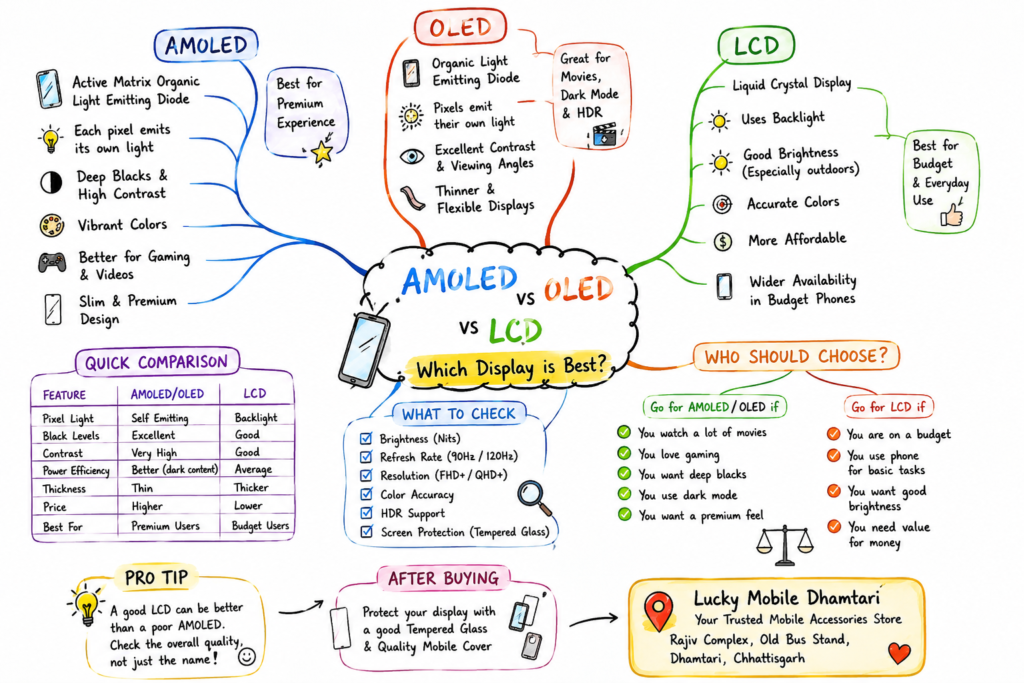
AMOLED vs OLED vs LCD: Which Smartphone Display Is Best?
When buying a new smartphone, most people compare the camera, processor, RAM and battery.
But there is one part of the phone you use almost every minute:
The display.
You look at it while watching YouTube, scrolling Instagram, replying to WhatsApp messages, playing games, reading articles and checking maps.
That’s why choosing the right display can make a bigger difference to your everyday experience than many other specifications.
You may have seen smartphone displays described as:
AMOLED, OLED, Super AMOLED, LTPO AMOLED, IPS LCD and LCD.
But which one is actually better?
Is AMOLED better than OLED?
Is OLED always better than LCD?
Does a higher refresh rate mean a better screen?
And what should you check before buying a phone?
Whether you’re buying a smartphone in India, the US or anywhere else, this guide will help you understand the differences without getting lost in technical terms.
And for readers searching for a mobile shop in Dhamtari or looking for accessories after buying a new phone, we’ll also cover what screen protection you should consider.
AMOLED vs OLED vs LCD: The Simple Answer
For many smartphone buyers, a good AMOLED or OLED display offers a more premium visual experience than a typical LCD.
The biggest advantage is the way OLED pixels produce light individually.
This allows OLED-based displays to produce very deep blacks and high contrast.
LCD displays work differently because they use a backlight behind the display.
However, there is an important point:
A good LCD can be better than a poor-quality AMOLED display.
So don’t choose a smartphone only because the specification says “AMOLED.”
Brightness, resolution, refresh rate, color tuning, outdoor visibility and overall panel quality also matter.
What Is OLED?
OLED stands for:
Organic Light-Emitting Diode
The easiest way to understand OLED is this:
The pixels can produce their own light.
Because of this, an OLED display does not need the same type of separate backlight used by an LCD.
When a pixel needs to display black, it can turn off.
That produces one of OLED’s most noticeable advantages:
Deep blacks and high contrast.
This can make movies, photos and dark scenes look much better.
What Is AMOLED?
AMOLED stands for:
Active Matrix Organic Light-Emitting Diode.
AMOLED is a type of OLED technology.
The active-matrix system controls the individual pixels electronically.
That’s why the terms OLED and AMOLED are sometimes confusing for smartphone buyers.
Instead of thinking:
OLED vs AMOLED
as completely different technologies, think of AMOLED as one implementation of OLED technology.
When shopping for a smartphone, the more useful question is:
How good is the actual display?
What Is LCD?
LCD stands for:
Liquid Crystal Display.
Unlike OLED-based screens, LCD displays use a backlight.
The light passes through layers of the display to create the image you see.
LCD technology has been used in smartphones for many years and remains popular, particularly in affordable smartphones.
A good IPS LCD can still provide:
- Sharp images
- Good colors
- Good brightness
- Smooth scrolling
- Excellent value
So LCD doesn’t automatically mean “bad display.”
AMOLED vs OLED vs LCD Comparison
| Feature | AMOLED / OLED | LCD / IPS LCD |
|---|---|---|
| Individual pixels produce light | Yes | No |
| Backlight required | No | Yes |
| Black levels | Excellent | Usually not as deep |
| Contrast | Very high | Good |
| Colors | Can be very vibrant | Can also be excellent |
| Thin design | Excellent | Generally thicker |
| Dark-mode efficiency | Can be better | Usually less efficient for dark content |
| Burn-in possibility | Yes | Much less of a concern |
| Common in | Mid-range & premium phones | Budget & mid-range phones |
| Premium experience | Often excellent | Depends heavily on panel quality |
This is a general comparison. The actual experience depends on the individual phone and display panel.
Why Do AMOLED Displays Have Better Blacks?
This is where OLED technology becomes very interesting.
Imagine your phone is displaying a completely black image.
With an OLED-based display, those pixels can switch off.
With LCD, the backlight is still operating.
That’s why OLED can produce extremely deep black levels.
This is especially noticeable when:
- Watching movies at night
- Using dark mode
- Looking at black backgrounds
- Playing games with dark scenes
- Viewing HDR content
The difference can be surprisingly noticeable when you compare two phones side by side.
AMOLED vs LCD: Which Has Better Colors?
This is not as simple as saying:
AMOLED = better colors
AMOLED displays are capable of very vibrant colors, but manufacturers can tune their screens differently.
One phone may use a vivid color profile.
Another may focus on more natural-looking colors.
A high-quality LCD can also have excellent color accuracy.
So when comparing phones, try to view:
- Skin tones
- Photos
- White backgrounds
- Dark images
- Videos
Don’t judge the display only by how colorful it looks in a shop.
AMOLED vs LCD for YouTube, Netflix and Movies
For people who watch a lot of video, OLED-based displays can be very enjoyable.
The combination of:
Deep blacks + high contrast + strong colors
can make movies look more immersive.
This is particularly noticeable with dark scenes.
But remember that your overall viewing experience also depends on:
- Resolution
- Screen size
- Brightness
- HDR support
- Speakers
- Refresh rate
So don’t buy a phone based on panel technology alone.
AMOLED vs LCD for Gaming
Gamers should look beyond the display type.
A good gaming phone should have a combination of:
High refresh rate + fast response + good brightness + good touch response + strong processor
A 120Hz AMOLED display can provide an excellent gaming experience.
But a high-quality 120Hz LCD can also feel very smooth.
Therefore:
AMOLED does not automatically mean better gaming.
The complete specification matters.
What Is 60Hz, 90Hz, 120Hz and 144Hz?
Refresh rate tells you how frequently the display updates the image.
For example:
60Hz = 60 updates per second
90Hz = 90 updates per second
120Hz = 120 updates per second
144Hz = 144 updates per second
A higher refresh rate can make:
- Scrolling feel smoother
- Animations look smoother
- Supported games feel more responsive
- Menus feel more fluid
For many smartphone buyers, 120Hz has become a popular balance between smoothness and power consumption.
Is AMOLED Better for Battery Life?
It can be, depending on what is displayed.
Since OLED pixels can turn off individually, dark content can use less display power than it would on a backlit LCD under suitable conditions.
But don’t assume:
AMOLED = automatically longer battery life.
Battery life also depends on:
- Processor efficiency
- Battery capacity
- Screen brightness
- Refresh rate
- Mobile network
- Apps
- Gaming
- Software optimization
A smartphone with a large battery and efficient processor can outperform another phone even if both use the same display technology.
What Is LTPO AMOLED?
You may have noticed LTPO AMOLED on premium smartphones.
LTPO is a display backplane technology that can support variable refresh rates.
Instead of keeping the display at a high refresh rate constantly, a compatible phone can adjust the refresh rate depending on what you’re doing.
For example:
High refresh rate → scrolling
Lower refresh rate → static content
This can help balance smoothness and power efficiency.
For people buying premium phones, LTPO can be a useful feature to look for.
What Is Super AMOLED?
Super AMOLED is a Samsung display branding term.
It is related to AMOLED technology and integrates touch functionality into the display structure.
The important takeaway for buyers is:
Don’t treat OLED, AMOLED and Super AMOLED as completely unrelated technologies.
Instead, check the actual phone specifications.
Can AMOLED Burn In?
This is one of the disadvantages worth knowing.
OLED-based displays can experience:
Image retention or burn-in
under certain long-term usage conditions.
Modern smartphones use various techniques to reduce the risk.
Still, users who keep static elements on the screen for extremely long periods should be aware of the possibility.
For normal smartphone use, this usually isn’t something that should automatically stop you from buying an AMOLED phone.
Is LCD Still Worth Buying?
Yes.
A good LCD phone can still be an excellent choice.
LCD may make sense when:
- You have a limited budget
- You want maximum value
- You don’t care about extremely deep blacks
- The phone has a good-quality panel
- Other specifications are more important to you
A smartphone is a combination of many components.
You shouldn’t reject a phone simply because it doesn’t have AMOLED.
What Should You Check Before Buying a Smartphone Display?
Instead of asking only:
“Does this phone have AMOLED?”
check these points.
1. Brightness
This is extremely important for outdoor use.
A bright display is easier to see in sunlight.
2. Refresh Rate
90Hz and 120Hz can make everyday scrolling much smoother.
3. Resolution
Higher resolution can improve image and text sharpness.
4. Color Quality
Look for natural and accurate colors, not just extremely bright colors.
5. HDR Support
Useful if you frequently watch compatible high-quality video content.
6. Screen Size
A large display is great for videos, while a smaller screen may be easier to handle with one hand.
7. Screen Protection
Even the best display can break after a drop.
That’s where tempered glass becomes important.
New Smartphone? Don’t Forget Tempered Glass
After spending money on a new smartphone, one of the first accessories you should consider is a screen protector.
A good tempered glass should:
- Fit the exact phone model
- Maintain good touch sensitivity
- Provide proper edge coverage
- Keep the display clear
- Work properly with compatible fingerprint sensors
- Have good adhesive and finishing
Searches such as “tempered glass in Dhamtari” or “mobile accessories shop Dhamtari” are often made by people who have just bought or damaged a smartphone.
This is where a local accessory store becomes useful.
AMOLED vs OLED vs LCD: Which One Should You Choose?
Choose AMOLED / OLED if you:
- Watch lots of movies
- Want deep blacks
- Prefer strong contrast
- Play games frequently
- Want a premium-looking screen
- Prefer dark mode
- Want features such as high refresh rates and variable refresh rates
Choose LCD if you:
- Want to save money
- Are buying a budget smartphone
- Find a phone with an excellent LCD
- Care more about overall value
- Don’t need premium display features
There is no single display that is perfect for everyone.
What Should Indian Smartphone Buyers Look For?
For buyers in India, price-to-performance is often an important part of the decision.
Instead of spending extra money simply because a phone has AMOLED, compare the complete package.
Look at:
Display + processor + battery + camera + software + build quality + after-sales support
For example, a slightly more affordable smartphone with an excellent 120Hz display, good battery and reliable processor may be a better purchase than a more expensive phone chosen only because of the AMOLED label.
What About Buyers in the US and Other Countries?
The same principle applies globally.
Whether you’re shopping in:
- India
- United States
- United Kingdom
- Canada
- Australia
- UAE
- Southeast Asia
the display terminology is broadly the same.
The important difference is that smartphone models, specifications and prices can vary by country.
Always check the exact model available in your market.
How to Compare Two Smartphone Displays in Real Life
Here’s an easy test.
Put the two phones side by side and:
Step 1
Open the same photo.
Step 2
Open a white webpage.
Step 3
Play the same video.
Step 4
Open a dark image.
Step 5
Scroll through a webpage.
Step 6
Take both phones outdoors.
Now compare:
Brightness
Colors
Black levels
Smoothness
Viewing angles
Text clarity
This will tell you more than simply reading “AMOLED” on the box.
⭐ Lucky Mobile Dhamtari — Our Smartphone Display Tip
If you’re buying a new phone in Dhamtari, don’t choose the display based only on the word AMOLED.
Think about how you actually use your phone.
If you watch videos and play games, pay attention to refresh rate, brightness and colors.
If you’re mostly using WhatsApp, calls, browsing and social media, a good-quality LCD can still be perfectly suitable.
And after buying your phone, protect that display with a properly fitted tempered glass.
For local buyers searching for a mobile shop in Dhamtari, smartphone accessories in Dhamtari or tempered glass in Dhamtari, Lucky Mobile is located at:
Lucky Mobile
Rajiv Complex, Old Bus Stand, Dhamtari, Chhattisgarh
⭐ Lucky Mobile Dhamtari FAQ
Where is Lucky Mobile located in Dhamtari?
Lucky Mobile is located at Rajiv Complex, Old Bus Stand, Dhamtari, Chhattisgarh.
Can I buy tempered glass at Lucky Mobile Dhamtari?
Yes, you can visit Lucky Mobile to check available tempered glass and screen protection options for your smartphone.
Does Lucky Mobile sell mobile covers?
Yes, Lucky Mobile offers mobile covers for different smartphone models, subject to availability.
Can I buy chargers and data cables at Lucky Mobile?
Yes, you can visit Lucky Mobile to check the available chargers and data cables suitable for different smartphones.
Does Lucky Mobile sell power banks and earbuds?
Yes, Lucky Mobile offers various mobile accessories including power banks, earbuds and other smartphone accessories, subject to availability.
Can Lucky Mobile help me choose accessories for a new phone?
Yes. Tell us your smartphone model and what you need, and we can help you choose suitable accessories.
Related Products
Add natural links to your existing Lucky Mobile pages:
Mobile Accessories Buying Guide
Fast Charging vs Battery Health
Original vs Duplicate Mobile Accessories
Suggested Products
1. AMOLED Smartphone
2. 120Hz AMOLED Smartphone
3. Tempered Glass
4. Premium Mobile Cover
5. USB-C Fast Charger
6. USB-C Data Cable
Affiliate Disclosure
This article may contain affiliate links. If you purchase a product through these links, Lucky Mobile may earn a small commission at no additional cost to you.
Always check the latest product specifications, compatibility and seller information before purchasing.
Final Verdict
So, AMOLED vs OLED vs LCD — which is better?
For most people looking for a premium smartphone display, a good-quality AMOLED or OLED screen is an excellent choice.
You get:
Deep blacks
High contrast
Vibrant visuals
Premium viewing experience
But LCD is still a good option, especially when value and affordability matter.
The most important lesson is this:
Don’t buy a phone because one specification sounds impressive.
Look at the entire display.
Check the brightness.
Check the refresh rate.
Check the resolution.
Check the colors.
Check outdoor visibility.
And most importantly, consider how you actually use your phone.
If you’re buying a new smartphone in Dhamtari, visit a trusted local mobile shop in Dhamtari, compare the displays in person and choose the phone that feels right for you.
And once you’ve found the phone you like, don’t forget to protect the screen.
Better Display. Better Protection. Better Smartphone Experience.
Lucky Mobile Dhamtari
Rajiv Complex, Old Bus Stand, Dhamtari, Chhattisgarh
Your Trusted Mobile Accessories Store