
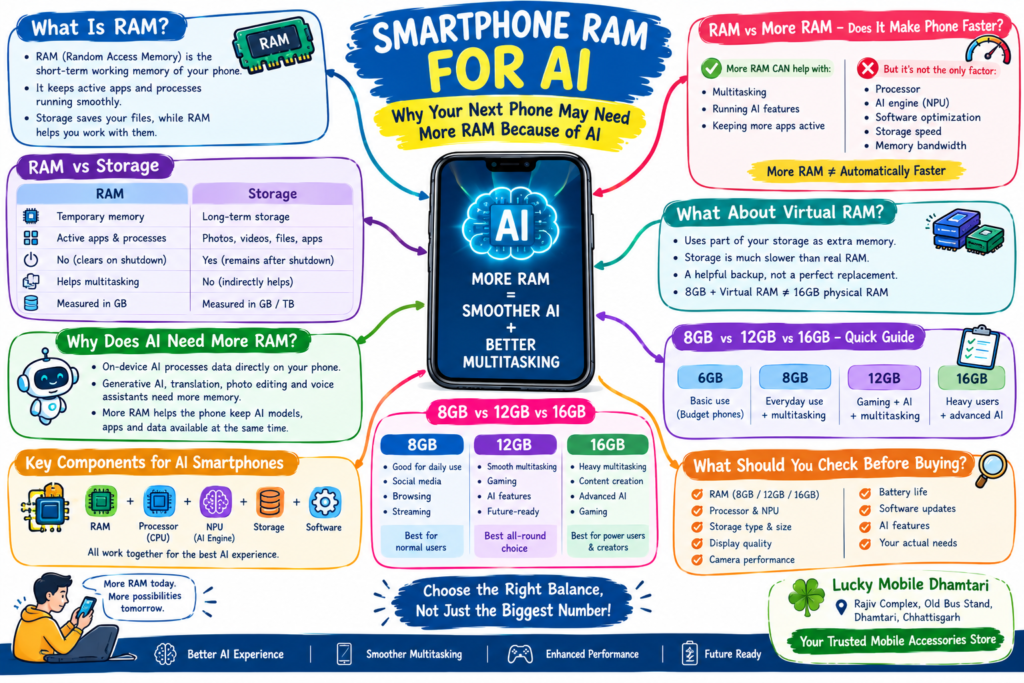
Why Your Next Phone May Need More RAM Because of AI
Remember when 4GB RAM was considered plenty for a smartphone?
Then 6GB became common.
After that, 8GB became popular.
Now you can find smartphones with:
12GB
16GB
and even higher memory configurations.
Naturally, this raises a question:
Why do smartphones need so much RAM?
The answer isn’t only about opening more apps.
Artificial intelligence is changing what smartphones are expected to do.
Modern phones are increasingly expected to process text, images, voice, translation, photography and other AI workloads directly on the device.
That means memory is becoming more important.
But there is a big misunderstanding:
More RAM does not automatically make every phone faster.
The real question is:
How much RAM does your phone actually need for the way you use it?
Let’s break it down.
What Is RAM in a Smartphone?
RAM stands for:
Random Access Memory.
It is the short-term working memory used by your smartphone while applications and system processes are running.
Think about it this way:
Storage = where your files live
RAM = where active work happens
Your phone’s storage contains things like:
- Photos
- Videos
- Apps
- Documents
- Music
- Downloads
RAM helps the phone keep active apps and processes available for quick access.
That’s why RAM is important for multitasking.
RAM vs Storage: What’s the Difference?
This is one of the most common smartphone questions.
| Feature | RAM | Storage |
|---|---|---|
| Main purpose | Temporary working memory | Long-term data storage |
| Holds | Active apps/processes | Photos, apps, videos, files |
| Data retained after shutdown | No | Yes |
| Helps multitasking | Yes | No |
| Helps app loading capacity | Yes | Indirectly |
| Measured in | GB | GB / TB |
So when a phone says:
12GB RAM + 256GB storage
those numbers refer to two completely different things.
You cannot treat 256GB of storage as equivalent to 12GB of RAM.
Why Does AI Need More RAM?
This is where smartphones are changing.
Traditional smartphone tasks such as calling, messaging and simple browsing aren’t necessarily extremely memory-intensive.
But modern AI features can require more resources.
Examples include:
- Generative AI
- AI image editing
- Real-time translation
- Voice assistants
- AI summarization
- Object recognition
- Image enhancement
- On-device language models
- AI-powered search
- Smart photography
Some of these tasks can run directly on the smartphone rather than sending everything to a remote server.
Qualcomm, for example, describes current Snapdragon platforms as supporting generative AI models directly on the device, including text, image and voice workloads. (qualcomm.com)
When more AI processing happens locally, the smartphone needs capable compute hardware and enough memory to keep everything running smoothly.
What Is On-Device AI?
On-device AI means AI processing happens directly on the smartphone.
Instead of:
Phone → Internet → Cloud server → Result
the phone can perform at least some of the work locally.
This can provide advantages such as:
Lower latency
Potentially better privacy
Offline capability for supported features
Less dependence on cloud connectivity
Qualcomm highlights on-device AI as a way to support real-time responses and privacy because data can be processed directly on the device. (qualcomm.com)
But local processing also places more demands on the phone’s hardware.
That’s where memory becomes increasingly important.
Does AI Automatically Mean You Need 16GB RAM?
No.
This is extremely important.
You shouldn’t read a headline about AI and immediately conclude:
“I need a 16GB RAM phone.”
Different AI workloads have different memory requirements.
A smartphone can use AI with:
8GB
12GB
16GB
or other configurations depending on the software, processor and specific features.
What matters is the complete system.
That includes:
RAM + processor + NPU + software + memory bandwidth + storage speed
What Is an NPU?
You may have noticed another term in AI smartphone specifications:
NPU
NPU stands for Neural Processing Unit.
It is specialized hardware designed to accelerate AI and machine-learning workloads.
Modern smartphone processors increasingly combine:
- CPU
- GPU
- NPU / AI engine
- ISP
- Memory subsystem
These components work together.
The NPU can handle specific AI tasks efficiently, while RAM provides working space for apps, operating-system processes and AI workloads.
So:
More RAM + weak AI hardware
doesn’t automatically beat:
Less RAM + strong processor/NPU + better software optimization
Why AI Can Increase Memory Pressure
Imagine you are using your phone to:
- Run your messaging app
- Keep several browser tabs open
- Edit a photo
- Use an AI assistant
- Play music
- Switch back to another application
The phone is juggling many processes.
AI features add another layer of processing.
Depending on the application, the system may need to keep data, models and intermediate results available while other apps continue running.
The more demanding the workload becomes, the more important memory capacity and memory bandwidth can become.
This is one reason the smartphone industry is moving toward memory solutions designed specifically for increasingly data-intensive AI workloads. Samsung’s current LPDDR6 documentation explicitly positions the memory technology for AI computing in mobile devices and emphasizes bandwidth and power efficiency. (semiconductor.samsung.com)
8GB vs 12GB RAM: Which Should You Buy?
For many users, 8GB can still be enough.
An 8GB smartphone can handle:
- Messaging
- Social media
- Web browsing
- Streaming
- Photography
- Normal multitasking
- Many mainstream apps
But 12GB can provide more headroom for:
- Heavy multitasking
- Gaming
- Long-term use
- AI features
- More demanding applications
- Keeping more apps active
So the answer isn’t:
12GB always wins.
It’s:
12GB gives you more memory headroom.
12GB vs 16GB RAM
The same idea applies here.
16GB can make sense for users who:
- Run demanding applications
- Multitask heavily
- Game for long periods
- Use advanced AI tools
- Work with large files
- Want maximum memory headroom
But many ordinary users may never notice a dramatic difference between 12GB and 16GB.
If you mainly use:
WhatsApp + Instagram + YouTube + Chrome + calls
you may not get a major everyday benefit simply from moving to 16GB.
Does More RAM Make a Phone Faster?
Not automatically.
RAM is only one component of performance.
Imagine two smartphones:
Phone A
16GB RAM
Older processor
Poor optimization
Phone B
12GB RAM
Newer processor
Better AI engine
Better software
Phone B could easily feel faster in real-world use.
So when buying a smartphone, don’t make the mistake of thinking:
More RAM = automatically faster phone
Instead compare:
RAM + processor + AI hardware + software + storage + display
Why Memory Bandwidth Also Matters
Capacity isn’t everything.
There’s another important concept:
Memory bandwidth.
Imagine RAM as a warehouse.
Capacity tells you:
How much can fit inside?
Bandwidth tells you:
How quickly can information move in and out?
AI workloads can move large amounts of data between memory and processing hardware.
That’s why newer mobile memory technologies focus not just on capacity but also on bandwidth, latency and power efficiency.
Samsung positions LPDDR6 as a next-generation low-power memory technology designed for data-intensive AI workloads, with higher bandwidth and improved efficiency compared with the previous generation. (semiconductor.samsung.com)
So the future of smartphone AI isn’t simply:
More GB
It’s also:
Faster and more efficient memory.
8GB vs 12GB vs 16GB: Simple Guide
| RAM | Best For | Recommendation |
|---|---|---|
| 6GB | Basic everyday use | Good for budget users |
| 8GB | Everyday + multitasking | Great for many users |
| 12GB | Heavy multitasking + gaming + AI | Excellent all-round choice |
| 16GB | Heavy users + advanced workloads | Best for demanding users |
These are practical categories, not strict technical limits.
Software optimization makes a major difference.
Should You Buy a Phone With 16GB RAM for Future-Proofing?
Maybe.
Future-proofing sounds attractive.
Nobody wants to buy a smartphone today and feel that it is outdated next year.
As AI features become more advanced, memory requirements may increase.
Counterpoint Research’s latest smartphone specification research says on-device generative AI is increasing baseline hardware requirements, with memory specifically highlighted as one of the areas affected. (counterpointresearch.com)
That doesn’t mean every user needs 16GB.
But it does suggest that memory will become a more important consideration as smartphones take on heavier AI workloads.
What Is Virtual RAM?
You may see smartphone advertisements mentioning:
8GB RAM + 8GB Virtual RAM
It sounds like the phone has 16GB of RAM.
It doesn’t.
Virtual RAM uses part of the phone’s storage as additional memory space.
Storage is much slower than dedicated RAM, so virtual RAM should not be treated as a perfect replacement for physical RAM.
Think of it as a backup mechanism rather than the same thing as adding real RAM.
Therefore:
8GB physical RAM + virtual RAM ≠ 16GB physical RAM
This distinction is important when comparing smartphones.
Does AI Use More RAM Than Normal Apps?
Potentially, depending on the AI task.
An AI chatbot, image-generation model, language model or advanced photo editor may require considerably more resources than a basic calculator or messaging app.
But applications can be optimized in different ways.
Some AI workloads can be compressed, quantized or divided across different processing components.
That’s why you shouldn’t assume that:
One AI feature = a fixed amount of RAM
There is no universal number.
Why AI Smartphones Need Better Hardware
Think about a modern AI phone as a team.
CPU
Handles general-purpose tasks.
GPU
Handles graphics and certain parallel workloads.
NPU
Accelerates AI and machine-learning tasks.
RAM
Keeps active data available.
Storage
Stores apps, photos, videos and other data.
Software
Coordinates everything.
All of these components work together.
This is why smartphone specifications should always be considered as a package.
What Can AI Actually Do on a Smartphone?
As AI becomes more integrated into phones, users can see features such as:
Live translation
Voice summarization
AI photo editing
Object removal
Writing assistance
Call-related features
Smart search
Personal assistants
Image generation
Text summarization
Camera scene recognition
Many of these can use a combination of on-device and cloud processing.
The exact feature set depends on the smartphone manufacturer and software.
Is More RAM Better for Gaming?
For gaming, RAM matters.
But it’s not the only thing that matters.
A gaming smartphone also needs:
- Strong GPU
- Capable processor
- Good cooling
- Fast storage
- High-refresh-rate display
- Good touch response
- Stable software
A phone with 16GB RAM and weak graphics performance won’t necessarily beat a well-designed 12GB gaming phone.
For gaming, the entire system matters.
Is 12GB RAM Enough for AI?
For many users, yes.
A 12GB smartphone can provide a comfortable amount of memory for:
- Everyday apps
- Multitasking
- Gaming
- Camera processing
- Many AI features
- Long-term use
But requirements vary.
Some advanced AI workloads may benefit from more memory, especially as larger models are run locally.
So 12GB is a strong middle ground rather than a universal requirement.
Is 8GB RAM Enough in 2026?
For many users, yes.
If your main activities are:
Calls
YouTube
Browsing
Music
Photography
8GB can still provide a very good experience when paired with a capable processor and well-optimized software.
However, users who specifically want advanced on-device AI, heavy multitasking or demanding gaming may prefer 12GB or more.
Is 16GB RAM Overkill?
For a normal smartphone user:
It can be.
For a power user:
Not necessarily.
If you frequently:
- Run many apps
- Edit photos and videos
- Play demanding games
- Use AI applications
- Keep large workloads open
- Use your phone as a productivity device
then extra memory can be useful.
The important thing is to pay for it because you need it, not because the number sounds impressive.
What RAM Should You Choose?
Here’s an easy rule.
Choose 8GB if:
You want a balanced phone for normal daily use.
Choose 12GB if:
You want strong multitasking and additional headroom for demanding apps and AI features.
Choose 16GB if:
You’re a heavy user, gamer, creator or enthusiast who regularly uses demanding workloads.
Don’t decide based on RAM alone if:
The phone has a weak processor, poor software or other significant limitations.
Smartphone RAM Buying Guide for India
For Indian buyers comparing smartphones across different price segments, it’s easy to get distracted by memory numbers.
A phone advertised with:
16GB RAM
may sound like an obvious winner.
But before buying, compare:
Processor
RAM
Storage type
AI engine
Display
Camera
Battery
Software support
Build quality
A balanced smartphone with 12GB RAM may offer better overall value than a poorly optimized 16GB phone.
If You’re Buying a Smartphone in Dhamtari
If you’re comparing phones at a mobile shop in Dhamtari, ask more than:
“How much RAM does this phone have?”
Ask:
What processor does it use?
Does it support the AI features I want?
How much storage does it have?
How long will the software be supported?
Is the display good?
How good is the camera?
This gives you a much better buying decision.
And once you buy your smartphone, don’t forget the basic accessories.
A quality mobile cover and tempered glass can help protect your investment.
For customers looking for mobile accessories in Dhamtari, Lucky Mobile is located at:
Lucky Mobile
Rajiv Complex, Old Bus Stand, Dhamtari, Chhattisgarh
⭐ Lucky Mobile Dhamtari-Our RAM Buying Tip
Don’t buy a smartphone just because it has the biggest RAM number on the box.
For most people:
8GB = good
12GB = excellent headroom
16GB = mainly for heavier users
Instead, look at the entire phone.
A good processor, efficient software, capable AI hardware and adequate RAM can provide a much better experience than simply chasing the highest memory number.
And after choosing your smartphone, protect it with the right cover and tempered glass.
Lucky Mobile
Rajiv Complex, Old Bus Stand, Dhamtari, Chhattisgarh
Your Trusted Mobile Accessories Store
⭐ Lucky Mobile Dhamtari FAQ
Where is Lucky Mobile located in Dhamtari?
Lucky Mobile is located at Rajiv Complex, Old Bus Stand, Dhamtari, Chhattisgarh.
Can I buy accessories for a new AI smartphone at Lucky Mobile?
Yes. Lucky Mobile offers accessories such as mobile covers, tempered glass, chargers, data cables, power banks and earbuds, subject to availability.
Can I buy tempered glass for my new smartphone at Lucky Mobile Dhamtari?
Yes, you can visit Lucky Mobile to check available tempered glass and screen-protection options for your smartphone model.
Does Lucky Mobile sell mobile covers?
Yes, Lucky Mobile offers mobile covers for different smartphone models, subject to availability.
Can Lucky Mobile help me choose accessories for a new smartphone?
Yes. Tell us your exact smartphone model and what accessories you need, and we can help you choose suitable options.
Related Blog
- AI Phones in 2026
- AMOLED vs OLED vs LCD
- 120Hz vs 144Hz vs 165Hz
- Why Smartphone Cameras Are Moving Beyond Megapixels
- Variable Aperture Smartphone Cameras
- Periscope Cameras Explained
- Wi-Fi 7 on Smartphones
- Mobile Covers
- Tempered Glass
- USB-C Charger vs USB-C Cable
Affiliate Disclosure
This article may contain affiliate links. If you purchase a product through these links, Lucky Mobile may earn a small commission at no additional cost to you.
Always check the latest smartphone specifications, software features, compatibility and seller information before purchasing.
Final Verdict
AI is changing the smartphone hardware equation.
In the past, RAM was mainly discussed in terms of:
How many apps can I keep open?
Now the question is becoming:
How much memory can my phone dedicate to increasingly advanced AI workloads while still handling everything else?
That doesn’t mean everyone needs 16GB.
For many people:
8GB is enough.
For users who want more multitasking and AI headroom:
12GB is a strong choice.
For power users, gamers and people who expect to use demanding workloads for years:
16GB can make sense.
But don’t forget the bigger picture.
RAM + Processor + NPU + Software + Storage + Battery = Smartphone Experience
Don’t buy the biggest number.
Buy the right combination for the way you use your phone.
Lucky Mobile Dhamtari
Rajiv Complex, Old Bus Stand, Dhamtari, Chhattisgarh
Your Trusted Mobile Accessories Store