
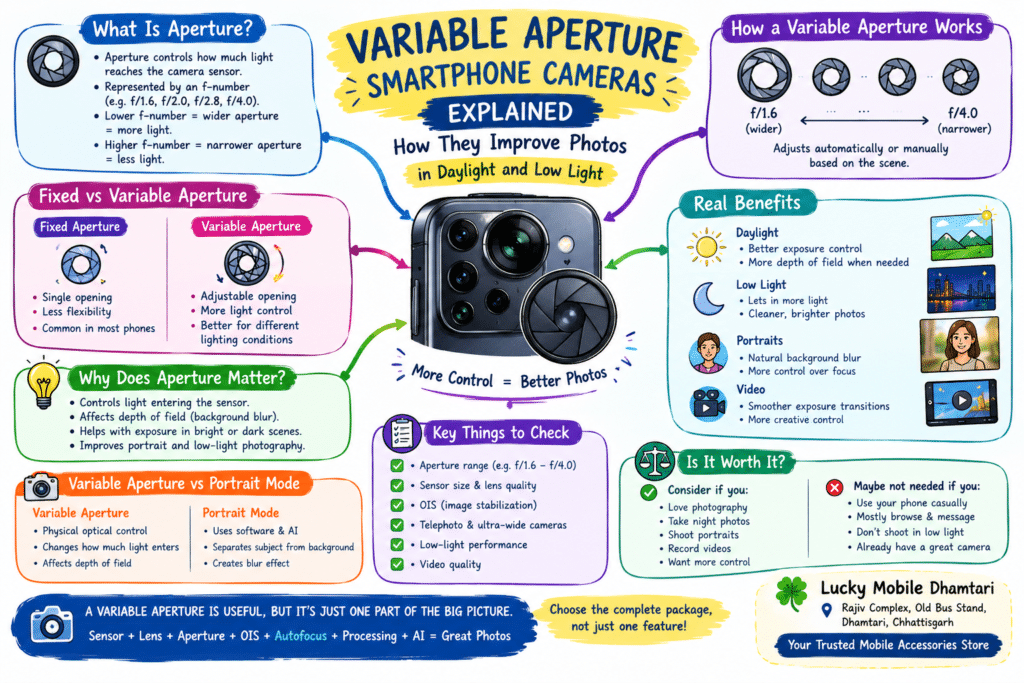
Variable Aperture Smartphone Cameras Explained: How They Improve Photos
Smartphone cameras have come a long way.
A few years ago, most camera-phone discussions focused on megapixels.
Then manufacturers started talking about:
Larger sensors
OIS
Periscope zoom
Computational photography
AI photography
Now another camera feature is becoming increasingly interesting:
Variable aperture.
But what does variable aperture actually mean?
And does it make a smartphone camera better?
Can it improve night photography?
Can it create better portraits?
Does it help in bright sunlight?
Most importantly:
Is a variable aperture camera worth paying extra for?
Let’s understand it in simple language.
What Is Aperture in a Smartphone Camera?
Aperture is an opening in the camera’s optical system that controls how much light reaches the camera sensor.
It is generally represented using an f-number, such as:
f/1.6
f/2.0
f/2.8
f/4.0
Here’s the important part:
A smaller f-number generally means a wider aperture.
A wider aperture allows more light to reach the sensor.
A narrower aperture allows less light through.
Aperture can also influence depth of field, which affects how much of the scene appears sharply focused versus blurred.
What Is a Variable Aperture Smartphone Camera?
A variable aperture smartphone camera can change the size of its aperture.
Instead of having only one fixed opening, the camera can adjust between different aperture settings.
For example, a camera might operate around:
Wide aperture → more light
and then:
Narrower aperture → less light and potentially more depth of field
Some smartphone cameras have used physical variable-aperture systems that allow the lens to change how much light reaches the sensor.
Xiaomi, for example, has used a stepless variable aperture system ranging from approximately f/1.63 to f/4.0 in the main camera of its Xiaomi 14 Ultra.
This gives the camera more optical control than a traditional fixed-aperture smartphone camera.
Fixed Aperture vs Variable Aperture
Most smartphone cameras have a fixed aperture.
For example:
Camera → f/1.8
The camera uses that same physical aperture during normal operation.
A variable aperture camera can instead adjust the opening.
For example:
f/1.8 → f/2.8 → f/4.0
The exact values vary by smartphone.
Fixed Aperture
Simple optical design.
The aperture stays at one predetermined size.
Variable Aperture
The camera can physically adjust the aperture to suit different shooting conditions.
This can provide more flexibility.
Why Does Aperture Matter?
Think about your camera like your eye.
When there is not much light, you want more light to reach the sensor.
A wide aperture helps with that.
When there is plenty of light, you may not need as much light.
A narrower aperture can help control the amount of light reaching the sensor.
That’s why variable aperture can be useful across different lighting conditions.
Variable Aperture for Low-Light Photography
This is one of the biggest reasons photographers care about aperture.
A wider aperture allows more light to reach the sensor.
That can help when shooting:
- Night scenes
- Restaurants
- Indoor events
- Evening portraits
- Concerts
- Street photography
A wider aperture can allow the camera to capture more light without relying entirely on longer exposure times or extreme software processing.
But there’s an important point:
Variable aperture doesn’t automatically make every night photo better.
Sensor size, OIS, image processing, lens quality and software all remain important.
A smartphone with a large sensor and excellent processing can outperform another phone with similar aperture specifications.
Variable Aperture in Bright Daylight
You might wonder:
Why would I need a narrower aperture when there is already plenty of sunlight?
Because sometimes the camera benefits from controlling how much light reaches the sensor.
A narrower aperture can help manage exposure in very bright conditions.
It can also increase the depth of field.
This can be useful for certain photography situations where you want more of the scene to remain in focus.
Variable Aperture and Portrait Photography
This is another interesting use.
A wider aperture can contribute to a shallower depth of field, which can produce stronger background blur in suitable optical conditions.
That can help make the subject stand out.
For example:
Person → sharp
Background → softer
This is one reason wider apertures are associated with portrait photography.
But smartphone portrait photography is not controlled by aperture alone.
Modern phones also use:
- Multiple cameras
- Depth information
- Computational photography
- AI processing
to create portrait effects.
So don’t assume:
Wider aperture = automatically better portrait.
Why a Variable Aperture Is Different From Portrait Mode
This distinction is important.
Variable Aperture
Uses physical optical control to change how light enters the camera and influence optical characteristics such as depth of field.
Portrait Mode
Usually relies heavily on software and computational processing to separate the subject from the background and create a blur effect.
A smartphone can have excellent portrait mode without having a variable aperture camera.
And a phone with variable aperture can still use computational photography to improve the final image.
They are different technologies that can work together.
Variable Aperture vs Software Blur
Imagine you’re taking a portrait.
With software blur, the phone attempts to identify:
Person → foreground
Background → blur
The phone then generates the effect computationally.
With optical aperture control, the lens itself can influence the depth of field.
The best smartphone camera systems can combine both approaches.
That can produce more natural-looking results in certain situations.
Does a Variable Aperture Improve Image Quality?
It can, but not in every situation.
The advantage is that the camera gets an additional optical control mechanism.
Instead of always using one aperture setting, it can adapt.
That can help with:
Light control
Depth of field
Portraits
Bright scenes
Low-light photography
But the final image still depends on the complete camera system.
Think of it like this:
Sensor + lens + aperture + stabilization + processor + software = final image
Variable aperture is one part of that equation.
Does a Wider Aperture Always Mean a Better Camera?
No.
This is another common misunderstanding.
A smartphone with an extremely wide aperture isn’t automatically a better camera.
Camera performance also depends on:
- Sensor size
- Sensor quality
- Lens quality
- OIS
- Autofocus
- Image processing
- HDR
- Noise reduction
- Color science
A good smartphone camera needs all these elements to work together.
What Does f/1.6 vs f/4.0 Mean?
Let’s make it simple.
f/1.6
Wider aperture.
More light can enter.
Shallower depth of field can be possible.
f/4.0
Narrower aperture.
Less light enters.
Greater depth of field can be possible.
The exact visual effect depends on the sensor, focal length, subject distance and optical design.
But the basic concept is:
Lower f-number = wider aperture
Higher f-number = narrower aperture
Why Smartphone Manufacturers Are Bringing Back Variable Aperture
Traditional cameras have used adjustable apertures for many years.
Smartphone manufacturers have been trying to fit more advanced camera hardware into extremely small devices.
Variable aperture is one way of giving a smartphone camera more optical flexibility.
Xiaomi’s official specifications, for example, describe its variable aperture system as providing stepless light control from approximately f/1.63 to f/4.0.
Samsung has also used variable-aperture camera systems in previous smartphone designs, noting that aperture can be adjusted according to the shooting environment.
The broader trend is clear:
Smartphone cameras are gaining more physical control instead of depending entirely on software.
Variable Aperture vs Fixed Aperture: Comparison
| Feature | Fixed Aperture | Variable Aperture |
|---|---|---|
| Aperture size | Fixed | Adjustable |
| Light control | Limited | More flexible |
| Low-light flexibility | Good, depending on lens | Potentially better |
| Depth-of-field control | Limited | More control |
| Portrait potential | Good | Additional optical flexibility |
| Hardware complexity | Lower | Higher |
| Cost | Usually simpler | Can be more expensive |
| Importance | Still very useful | Useful for advanced camera systems |
This is a general comparison. Implementation differs between smartphones.
Is Variable Aperture Useful for Video?
It can be.
Imagine you’re recording video while moving from:
Indoor room → bright outdoor area
A camera with optical aperture control has another mechanism it can use to manage exposure.
That can potentially make exposure transitions more flexible.
However, smartphone video quality depends on much more:
- Stabilization
- Sensor
- Autofocus
- HDR
- Frame rate
- Processing
- Microphones
- Lens quality
So again, variable aperture is an advantage, not a guarantee.
Variable Aperture and Smartphone Camera AI
Modern smartphone cameras increasingly combine physical hardware with computational photography.
Think of the system as:
Optics → Sensor → Processor → AI → Final Photo
The aperture controls incoming light.
The sensor captures the image.
The processor and software then analyze and process that information.
AI can help with:
- Scene recognition
- Noise reduction
- Portrait enhancement
- HDR
- Object recognition
- Image sharpening
This is why today’s smartphone photography is much more than simply pointing a camera and pressing the shutter.
Do You Need a Variable Aperture Phone?
For most people:
No, it isn’t essential.
You can take excellent photos with a fixed-aperture smartphone.
A variable aperture becomes more interesting if you:
- Take lots of photos
- Enjoy smartphone photography
- Shoot portraits
- Photograph at night
- Want more optical control
- Record videos frequently
- Prefer advanced camera hardware
For casual users, a phone with a good fixed-aperture camera can still be an excellent choice.
Who Should Consider a Variable Aperture Smartphone?
Photography Enthusiasts
You may appreciate the extra control.
Night Photographers
More optical flexibility can be useful in difficult lighting.
Portrait Photographers
Aperture control can contribute to depth-of-field effects.
Content Creators
More camera flexibility can be useful for both photos and video.
Travelers
You can use different camera settings for changing environments.
Everyday Users
It can be a nice feature, but it shouldn’t automatically be the reason you choose one phone over another.
What Should You Check When Buying a Camera Phone?
Don’t look only for:
Variable Aperture
Instead, check the complete camera system.
1. Sensor Size
A larger sensor can help with light gathering and image quality.
2. Aperture
Check the available aperture range.
3. OIS
Optical stabilization is very useful for handheld photography.
4. Telephoto Camera
Useful for portraits and distant subjects.
5. Ultra-Wide Camera
Useful for landscapes and groups.
6. Low-Light Performance
Look at real photos rather than specifications alone.
7. Video Quality
Check stabilization, autofocus and available recording modes.
8. Image Processing
Software can dramatically affect the final image.
How to Test Variable Aperture on a Smartphone
If you’re able to test a compatible smartphone, try several situations.
Test 1 — Outdoor Bright Light
Take a photo in strong daylight.
Test 2 — Portrait
Photograph a person against a detailed background.
Test 3 — Indoor
Take a photo in a moderately dark room.
Test 4 — Night
Photograph lights and darker areas.
Test 5 — Close-Up
Photograph an object from relatively close range.
Compare the results.
The goal isn’t simply to see whether the aperture changes.
You’re looking for whether the camera produces useful differences in:
Exposure + depth of field + detail + noise + overall image quality
Variable Aperture vs Megapixels
Which should you care about more?
The answer is:
Neither one should be considered alone.
A 200MP camera doesn’t automatically beat a 50MP camera.
Likewise, a variable aperture doesn’t automatically beat a fixed-aperture camera.
Compare the complete system.
Sensor
Lens
Aperture
OIS
Processing
Autofocus
Zoom
Video
These together determine camera performance.
Variable Aperture vs Periscope Zoom
These two technologies solve completely different problems.
Variable Aperture
Controls incoming light and can affect depth of field.
Periscope Camera
Provides longer focal lengths for greater optical zoom.
A premium smartphone may use both.
This is why modern smartphone camera systems can have:
Variable aperture + main sensor + telephoto + periscope + OIS + computational photography
The goal is to make a smartphone camera more versatile.
Best Smartphone Camera: What Should You Actually Look For?
Instead of asking:
“Which phone has the biggest camera?”
ask:
“Which phone gives me the best results for the photos I actually take?”
For example:
If you love portraits
Look for:
Good main camera + telephoto + portrait processing + aperture control
If you take night photos
Look for:
Large sensor + wide aperture + OIS + strong processing
If you make videos
Look for:
Good stabilization + autofocus + microphones + strong video processing
If you travel
Look for:
Main + ultra-wide + telephoto + good battery
This approach is much more useful than chasing one specification.
Camera Phone Buying Guide for India
Indian smartphone buyers often have many choices across different price segments.
Before buying, compare the actual camera results rather than relying completely on marketing numbers.
A phone with:
50MP + excellent sensor + OIS + good processing
can be a better camera phone than:
200MP + weaker sensor + poor processing
The same principle applies to aperture.
Don’t choose a phone solely because it has variable aperture.
Look at the complete package.
If You’re Buying a Camera Phone in Dhamtari
If you’re searching for a camera phone in Dhamtari or visiting a smartphone shop in Dhamtari, try the camera before making your final decision.
Take a few test photos.
Compare:
Daylight
Indoor
Portrait
Zoom
Night
Also check the display because a good screen helps you judge photos more accurately.
Once you have selected your phone, protecting it is equally important.
A quality mobile cover and properly fitted tempered glass can help protect your expensive smartphone.
For readers searching for mobile accessories in Dhamtari, Lucky Mobile is located at:
Lucky Mobile
Rajiv Complex, Old Bus Stand, Dhamtari, Chhattisgarh
⭐ Lucky Mobile Dhamtari — Our Camera Phone Tip
Don’t buy a smartphone just because the box says:
“200MP Camera”
or:
“Variable Aperture.”
Ask what the entire camera system can actually do.
Check:
Sensor + Lens + Aperture + OIS + Zoom + Processing + Video
And if possible, test the camera yourself before buying.
At Lucky Mobile Dhamtari, you can also check compatible accessories such as mobile covers and tempered glass after choosing your smartphone.
Lucky Mobile
Rajiv Complex, Old Bus Stand, Dhamtari, Chhattisgarh
Your Trusted Mobile Accessories Store
⭐ Lucky Mobile Dhamtari FAQ
Where is Lucky Mobile located in Dhamtari?
Lucky Mobile is located at Rajiv Complex, Old Bus Stand, Dhamtari, Chhattisgarh.
Can I buy a mobile cover for my new camera phone at Lucky Mobile?
Yes. Tell us your exact smartphone model and we can check the available compatible covers.
Can I buy tempered glass in Dhamtari from Lucky Mobile?
Yes, you can visit Lucky Mobile to check available tempered glass and screen-protection options for your smartphone.
Does Lucky Mobile sell chargers and USB-C cables?
Yes, you can visit Lucky Mobile to check the available chargers and charging/data cables suitable for compatible smartphones.
What other mobile accessories are available at Lucky Mobile Dhamtari?
Lucky Mobile offers accessories including mobile covers, tempered glass, chargers, data cables, power banks, earbuds and other smartphone accessories, subject to availability.
related Article
Add these links naturally within the article:
- Why Smartphone Cameras Are Moving Beyond Megapixels
- Periscope Cameras Explained
- AMOLED vs OLED vs LCD
- 120Hz vs 144Hz vs 165Hz
- USB-C Charger vs USB-C Cable
- Fast Charging vs Battery Health
- Mobile Covers
- Tempered Glass
Suggested Products
1. Smartphone With Variable Aperture Camera
2. Camera Smartphone With OIS
3. Camera Phone With Telephoto / Periscope Camera
4. Premium Mobile Cover
5. Tempered Glass
6. USB-C Fast Charger
Affiliate Disclosure
This article may contain affiliate links. If you purchase a product through these links, Lucky Mobile may earn a small commission at no additional cost to you.
Always check the manufacturer’s latest specifications, compatibility and seller information before purchasing.
Final Verdict
A variable aperture smartphone camera is an interesting step forward in mobile photography because it gives the camera more control over incoming light and optical characteristics.
But it isn’t a magic feature.
A smartphone camera is a complete system.
Sensor
Lens
Aperture
OIS
Autofocus
Zoom
Image processing
AI
Video
All of these work together to create the photograph you see.
So when buying your next camera phone, don’t ask only:
“How many megapixels does it have?”
And don’t ask only:
“Does it have variable aperture?”
Ask the better question:
“Does this camera produce the kind of photos and videos I actually want?”
That is what matters.
Lucky Mobile Dhamtari
Rajiv Complex, Old Bus Stand, Dhamtari, Chhattisgarh
Your Trusted Mobile Accessories Store