
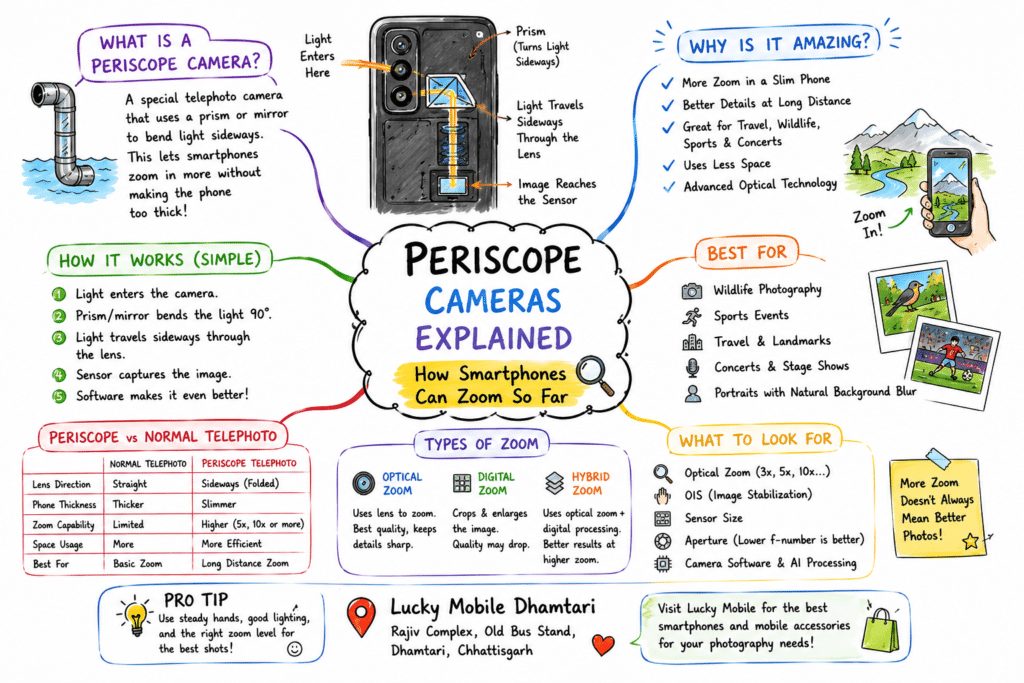
Periscope Cameras Explained: How Smartphones Can Zoom So Far
Have you ever looked at a smartphone specification and wondered how a phone only a few millimetres thick can zoom in on objects that are far away?
Some modern smartphones advertise 5x optical zoom, 10x optical zoom and even higher hybrid zoom levels.
A traditional camera needs a physically long lens to achieve long-range magnification.
So how does a thin smartphone do it?
The answer is periscope camera technology, also called a folded telephoto or folded-optics system.
Instead of sending light straight through the phone from the back to the sensor, a prism or mirror redirects the light sideways. This allows manufacturers to fit a much longer optical path inside the phone without making the entire smartphone extremely thick.
Let’s understand how it works.
What Is a Periscope Camera?
A periscope camera is a specialized type of telephoto camera designed to provide greater optical zoom inside a relatively thin smartphone.
The basic idea is clever:
Light enters the phone → prism redirects the light → light travels sideways through the lens system → sensor captures the image.
The sideways arrangement creates extra room for the camera’s optical path.
This is similar in principle to how a submarine periscope redirects light to allow you to see around a physical obstruction.
In smartphones, the same basic optical idea helps engineers fit longer focal lengths into a compact device.
Why Can’t a Normal Smartphone Camera Zoom That Far?
The problem is physical space.
A conventional telephoto lens is arranged more or less along the depth of the phone.
But smartphones are thin.
If manufacturers tried to create an extremely long telephoto lens in a conventional arrangement, the camera module would become much larger and could protrude significantly from the phone.
A periscope design solves part of this problem by turning the optical path sideways.
So instead of:
Lens → Lens → Lens → Sensor
in a straight line through the phone,
you can have:
Lens → Prism → Sideways lens system → Sensor
This makes much longer optical paths possible within a compact body.
How Does a Periscope Camera Work?
The process can be explained in a few simple steps.
Step 1: Light Enters the Camera
Light from the subject enters through the camera opening on the back of the smartphone.
Step 2: A Prism Redirects the Light
A prism or mirror changes the direction of the incoming light, typically by around 90 degrees.
Step 3: Light Travels Sideways
The light then travels through the telephoto lens elements positioned horizontally inside the phone.
Step 4: The Lens Magnifies and Focuses
The lens system focuses the incoming image onto the sensor.
Step 5: The Sensor Captures the Image
The sensor converts the optical information into digital image data.
Step 6: Software Processes the Result
The smartphone may then use computational photography to improve detail, colour, exposure, sharpness and stabilization.
This combination of optics + sensor + software is what makes modern smartphone zoom so powerful.
Periscope Camera vs Normal Telephoto Camera
| Feature | Standard Telephoto | Periscope Telephoto |
|---|---|---|
| Optical path | More conventional | Folded sideways |
| Lens orientation | Mostly along phone depth | Sideways inside phone |
| Typical purpose | Moderate zoom | Longer-range optical zoom |
| Space requirement | Higher at long focal lengths | More efficient use of internal space |
| Common zoom range | Often around 2x–3x | Commonly around 3x–10x or more |
| Phone thickness challenge | Greater at long focal lengths | Reduced by folded design |
| Long-distance photography | Good | Excellent potential |
The actual zoom range varies significantly between smartphones.
What Is Optical Zoom?
Optical zoom is created using the physical optics of the camera.
The lens system changes the effective field of view so that a distant subject appears closer without simply cropping the original image.
This generally preserves more detail than basic digital cropping.
For example, if a smartphone has a dedicated 5x optical telephoto camera, it can optically frame a subject at roughly five times the magnification of its reference focal length.
However, the exact meaning of a phone’s “5x” or “10x” label depends on how the manufacturer defines its camera system.
What Is Digital Zoom?
Digital zoom works differently.
Instead of physically changing the optical magnification, the smartphone uses image data and crops or enlarges part of the captured image.
Basic digital zoom can result in:
- Loss of fine detail
- Softer images
- More visible noise
- Digital artifacts
But modern smartphones don’t always rely on simple cropping.
They can combine:
- High-resolution sensors
- Multiple cameras
- AI processing
- Multi-frame photography
- Super-resolution
- Image fusion
This is why a modern smartphone can produce surprisingly good images beyond the range of its pure optical zoom.
Optical Zoom vs Digital Zoom
| Feature | Optical Zoom | Digital Zoom |
|---|---|---|
| Uses physical optics | Yes | No |
| Changes optical magnification | Yes | No |
| Detail retention | Generally better | Can decrease as magnification increases |
| Hardware required | Dedicated lens system | Mostly software/image processing |
| Long-distance quality | Strong at supported range | Depends heavily on processing |
| Smartphone use | Telephoto/periscope cameras | Available through camera software |
The best modern smartphone zoom systems often combine both.
What Is Hybrid Zoom?
Hybrid zoom combines information from multiple sources.
A smartphone may use:
Main camera + telephoto camera + digital processing
to create a zoom result beyond the native optical range.
For example, a phone with a 5x periscope camera may use its telephoto sensor at 5x and then apply computational processing for higher zoom levels.
This can provide better results than ordinary digital enlargement.
Why Periscope Cameras Are Excellent for Long-Distance Photography
A periscope camera becomes useful when your subject is too far away for the main camera.
You can use it for:
Wildlife
Photograph animals without getting physically close.
Sports
Capture players and action from the stands.
Concerts
Get closer to performers when you’re far from the stage.
Travel
Photograph distant architecture and landmarks.
Portraits
Longer focal lengths can create attractive perspective and background separation.
Outdoor Photography
Capture details that aren’t visible with a wide-angle camera.
Moon and Distant Subjects
High-quality telephoto systems can make distant subjects significantly easier to capture.
However, extremely high digital zoom should not be confused with true optical detail.
Why Does 10x Zoom Shake So Much?
The higher the magnification, the more noticeable even tiny hand movements become.
Think about pointing a normal camera at a building.
A small hand movement may barely matter.
Now zoom in heavily.
That same movement becomes much more obvious.
This is why long-range smartphone cameras often use optical image stabilization (OIS) or other stabilization technologies.
OIS can help compensate for small movements while taking photographs.
Some periscope systems also use stabilization mechanisms within the optical assembly.
What Is OIS?
OIS stands for:
Optical Image Stabilization.
The camera system physically compensates for small movements.
This is particularly valuable for:
- Telephoto photography
- Low-light photography
- Video
- High-zoom shots
At higher magnification, stabilization becomes even more important because small movements are magnified along with the subject.
Does a Periscope Camera Improve Low-Light Photography?
Not automatically.
Long-range cameras can face a challenge in low light.
A telephoto lens may receive less light than the main camera depending on its aperture and sensor.
Manufacturers therefore use:
- Larger sensors
- Wider apertures
- OIS
- Multi-frame processing
- AI/computational photography
to improve telephoto images in difficult lighting.
Some smartphones may also switch to another camera at certain zoom levels when the dedicated telephoto camera doesn’t have enough light.
This is one reason real-world camera performance can differ from the specification sheet.
Why Does the Phone Sometimes Change Cameras During Zoom?
Modern smartphones can use several cameras.
For example:
Ultra-wide → Main → Telephoto
As you move through different zoom levels, the software may decide which camera is best for the current lighting and distance.
Sometimes the phone may use digital cropping from the main sensor rather than switching immediately to the telephoto sensor.
This can depend on:
- Lighting
- Zoom level
- Focus distance
- Camera software
- Sensor availability
- Image quality
The goal is to provide the best-looking result rather than simply switching cameras at a fixed number.
Is 5x Better Than 3x?
Not necessarily.
It depends on how you use the phone.
3x Telephoto
Can be excellent for:
- Portraits
- People
- Everyday zoom
- Street photography
5x Telephoto
Can be more useful for:
- Wildlife
- Sports
- Travel
- Concerts
- Distant objects
10x Optical Zoom
Useful when you regularly photograph subjects that are far away.
But a larger zoom range isn’t automatically better for every user.
What Should You Look For in a Smartphone Zoom Camera?
Don’t look only at the zoom number.
Check:
Optical Zoom
How much true optical magnification does the telephoto camera provide?
Sensor Size
Larger sensors can provide advantages in image quality and low-light performance.
Aperture
A wider aperture can allow more light to reach the sensor.
OIS
Important for stabilizing long-range images.
Autofocus
Accurate autofocus matters when photographing distant subjects.
Image Processing
Modern smartphone photography relies heavily on computational photography.
Telephoto Resolution
Higher resolution can provide more detail, but megapixels alone don’t determine camera quality.
5x Optical Zoom vs 50x Digital Zoom
This is something smartphone buyers often misunderstand.
Suppose a phone has:
5x optical zoom
and advertises:
50x or 100x digital/hybrid zoom
That does not mean the phone has 50x or 100x true optical magnification.
The higher number may involve:
- Digital cropping
- Sensor cropping
- Multiple cameras
- AI processing
- Image enhancement
The quality will generally become more dependent on software as you move farther beyond the phone’s native optical capability.
So when comparing smartphones, always ask:
“How much of this zoom is actually optical?”
Why Smartphone Zoom Is Getting More Advanced
Smartphone cameras are becoming increasingly sophisticated because manufacturers are combining better hardware with stronger computational photography.
The biggest improvements are not coming from one component alone.
They come from:
Better sensor + better optics + better stabilization + better processor + better software
That combination allows smartphones to produce images that would have been difficult on older phone cameras.
Modern phones can now combine long optical reach with software processing to cover a wide range of zoom levels.
Examples of Periscope and Folded Telephoto Technology
Several smartphone manufacturers now use folded-optics or periscope-style telephoto systems.
For example, OPPO’s Find X9 Ultra uses a redesigned quintuple-prism periscope system and offers 10x optical zoom, showing how far manufacturers are pushing folded camera designs.
Apple uses a related folded-optics approach in some iPhone telephoto systems, which it calls tetraprism.
The exact optical design differs between manufacturers, but the basic goal is similar:
Fit a longer optical path inside a thin phone.
Should You Buy a Phone With a Periscope Camera?
A periscope camera is particularly useful if you:
- Photograph wildlife
- Attend sports events
- Travel frequently
- Enjoy photography
- Photograph distant buildings
- Take portraits
- Want stronger zoom performance
You may not need one if you mostly use your camera for:
- Selfies
- WhatsApp photos
- Food pictures
- Indoor snapshots
- Basic social media
In that case, a good main camera may matter more.
⭐ Lucky Mobile Dhamtari – Our Camera Buying Tip
When choosing a smartphone with a powerful zoom camera, don’t simply look at:
“100x Zoom”
Ask what the phone actually provides.
Check:
- Optical zoom
- Telephoto camera
- OIS
- Sensor quality
- Low-light performance
- Image processing
- Video stabilization
At Lucky Mobile Dhamtari, we recommend choosing a smartphone according to your actual photography needs.
If you love travel, wildlife or long-distance photography, a dedicated periscope camera can be a valuable feature.
If you mostly take everyday photos, you may get more value from a phone with a stronger main camera, battery and display.
Lucky Mobile
Rajiv Complex, Old Bus Stand, Dhamtari, Chhattisgarh
⭐ Lucky Mobile Dhamtari FAQ
Where is Lucky Mobile located in Dhamtari?
Lucky Mobile is located at Rajiv Complex, Old Bus Stand, Dhamtari, Chhattisgarh.
Can I find smartphones with zoom cameras at Lucky Mobile?
You can visit Lucky Mobile and ask about the latest smartphones available with telephoto or periscope-style camera systems.
Can Lucky Mobile help me choose a camera phone?
Yes. Tell us whether you care most about portraits, travel, wildlife, video or everyday photography, and we can help you compare suitable smartphones.
Can I buy tempered glass for camera-focused smartphones at Lucky Mobile?
Yes. You can check available tempered-glass and screen-protection options for your exact smartphone model.
Does Lucky Mobile sell mobile covers for camera phones?
Yes. You can check available covers designed for different smartphone models and camera layouts.
Can I buy chargers, cables and power banks at Lucky Mobile?
Yes. Lucky Mobile offers mobile charging accessories and other smartphone accessories, subject to availability.
Related Article
AMOLED vs OLED vs LCD: Which Smartphone Display Is Best?
60Hz vs 90Hz vs 120Hz vs 144Hz vs 165Hz
Silicon-Carbon Batteries Explained
Best Mobile Phones from ₹15,000 to ₹35,000
Mobile Accessories Buying Guide
Fast Charging vs Battery Health
Suggested Products
Camera Phones With Periscope / Telephoto Cameras
Smartphone Tripod
Smartphone Gimbal
Portable Power Bank
Premium Smartphone Case
Camera Lens Protection
Affiliate Disclosure
Some links in this article may be affiliate links. If you purchase a product through these links, Lucky Mobile may earn a commission at no additional cost to you.
Always check the current smartphone specifications, camera configuration and seller information before purchasing.
Final Verdict
Periscope cameras are one of the smartest pieces of engineering inside modern smartphones.
Instead of making a phone extremely thick to accommodate a long telephoto lens, manufacturers can fold the optical path sideways using prisms or mirrors.
This creates more room for a longer lens system while keeping the smartphone relatively compact.
The result can be impressive long-range photography.
But remember:
5x optical zoom is not the same as 50x digital zoom.
And:
More zoom does not automatically mean a better camera.
When choosing a smartphone, look at the complete camera system:
Main camera + telephoto + sensor + aperture + OIS + processing
That’s how you determine whether a phone is actually good for photography.
If you’re in Dhamtari and planning to buy a new smartphone or need accessories for your camera phone, visit:
Lucky Mobile
Rajiv Complex, Old Bus Stand, Dhamtari, Chhattisgarh
Choose the right phone. Protect it properly. Capture more.