
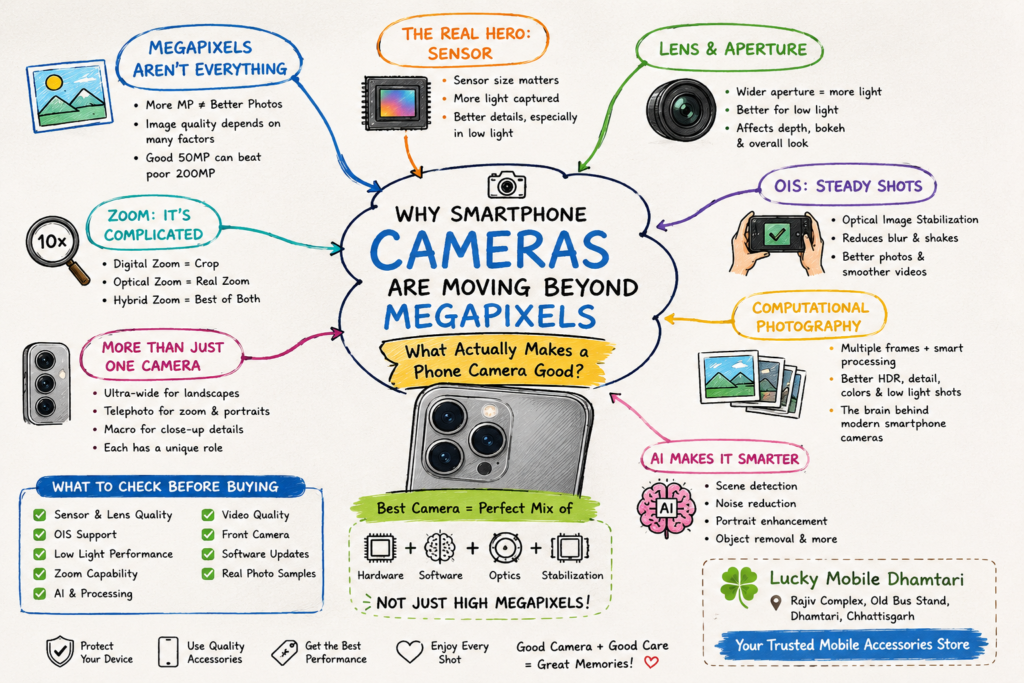
Why Smartphone Cameras Are Moving Beyond Megapixels
For years, smartphone camera marketing was incredibly simple.
12MP.
Then:
48MP.
Then:
64MP.
Then:
108MP.
And now we regularly see smartphones advertising 200MP cameras.
So it is easy to assume that a 200MP phone camera must automatically take better photos than a 50MP camera.
But that’s not how smartphone photography works.
The number of megapixels is only one part of the camera system.
Today’s smartphone cameras combine sensors, lenses, image stabilization, processors and computational photography to create the final photo. Modern phones can also use AI-based image processing for tasks such as scene understanding, noise reduction, HDR, portrait effects and zoom enhancement.
That means the better question is no longer:
“How many megapixels does the camera have?”
The better question is:
“How good is the complete camera system?”
What Does Megapixel Actually Mean?
Megapixel means:
One million pixels.
So:
12MP ≈ 12 million pixels
50MP ≈ 50 million pixels
108MP ≈ 108 million pixels
200MP ≈ 200 million pixels
More pixels can provide advantages such as higher potential detail and more flexibility when cropping an image.
But more pixels don’t automatically mean better photos.
A camera’s final image quality depends on much more than resolution.
Is a 200MP Camera Better Than a 50MP Camera?
Not necessarily.
This is one of the biggest smartphone camera myths.
A well-designed 50MP camera can produce better photos than a poorly implemented 200MP camera.
Why?
Because image quality also depends on:
- Sensor size
- Pixel size
- Lens quality
- Aperture
- Image stabilization
- Image signal processor
- Computational photography
- HDR processing
- Noise reduction
- Autofocus
- Software tuning
A high-resolution sensor can be useful, particularly for cropping and zoom-related processing, but megapixels alone aren’t a complete measure of camera quality.
Recent smartphone camera trends have increasingly emphasized computational photography, larger sensors and specialized zoom cameras alongside high-resolution sensors.
What Actually Makes a Smartphone Camera Good?
Think of a smartphone camera as a complete system.
1. Camera Sensor
The sensor captures the light entering through the lens.
Sensor size can have a major effect on photography.
A larger sensor can generally capture more light, although the final result also depends on lens design, pixel architecture and software processing.
This becomes particularly important in:
Low light
Night photography
Indoor photography
Portrait photography
So when comparing cameras, don’t look only at megapixels.
Look for information about the sensor size as well.
2. Lens and Aperture
The lens directs light onto the sensor.
The aperture controls how much light can enter.
A wider aperture can allow more light to reach the sensor.
That can be useful when photographing:
- People indoors
- Night scenes
- Restaurants
- Events
- Moving subjects in lower light
A wider aperture can also contribute to natural background separation in some situations.
However, aperture is only one part of the system.
3. OIS: Why Optical Image Stabilization Matters
You may have seen:
OIS
on a smartphone camera specification sheet.
OIS stands for:
Optical Image Stabilization.
It helps compensate for small movements of the phone during photography or video recording.
This can be especially useful when:
- Shooting at night
- Taking photos indoors
- Using zoom
- Recording handheld video
Without stabilization, small hand movements can make a photo blurry.
For anyone interested in camera quality, OIS can be much more useful than simply seeing a large megapixel number.
4. Computational Photography
This is where modern smartphone cameras have changed dramatically.
When you press the shutter button, your phone isn’t necessarily relying on a single frame and simply saving it.
Modern computational photography can combine multiple frames and apply sophisticated processing to:
- Reduce noise
- Improve HDR
- Preserve highlights
- Recover shadows
- Improve detail
- Balance colors
- Improve skin tones
- Enhance low-light photos
Computational photography has become a core part of mobile imaging rather than simply an extra camera feature. Academic reviews of mobile computational photography describe techniques including burst processing, noise reduction and super-resolution as fundamental parts of modern smartphone imaging.
This is one reason a phone with fewer megapixels can sometimes produce a better-looking photo than a phone with many more.
5. AI Camera Features
AI is becoming an increasingly important part of smartphone photography.
Modern camera software can help identify:
- Faces
- People
- Sky
- Food
- Buildings
- Animals
- Low-light scenes
- Backlit subjects
AI can also help with:
- Object removal
- Photo enhancement
- Portrait effects
- Sharpening
- Noise reduction
- Reframing
- Image selection
- Video stabilization
Samsung, for example, now describes AI imaging as a major part of its smartphone camera processing pipeline, alongside sensor hardware and image-processing technology.
This is why modern smartphone photography is becoming less about simply capturing an image and more about processing the image intelligently.
6. Zoom Is More Complicated Than You Think
Zoom is another area where megapixels can be misleading.
There are several types of zoom.
Digital Zoom
The phone enlarges or crops the image using software.
Optical Zoom
A dedicated lens provides actual optical magnification.
Hybrid Zoom
The phone combines optical and computational techniques.
When comparing camera phones, don’t ask only:
“How much zoom does it have?”
Ask:
“What type of zoom does it use?”
A dedicated telephoto or periscope camera can provide much better long-range results than simply cropping a normal camera image.
7. Why Periscope Cameras Matter
You may have noticed premium smartphones advertising:
Periscope telephoto camera
or
Periscope zoom
The design allows manufacturers to fit a longer optical path inside a relatively thin smartphone.
This makes greater optical zoom possible without making the phone physically as long as a traditional camera lens.
High-end smartphone cameras are increasingly focusing on long-range zoom, with 200MP sensors and specialized telephoto systems being used together rather than relying on megapixels alone.
8. Low-Light Photography
A camera that takes fantastic daytime photos but poor night photos isn’t necessarily a great all-round camera.
Low-light performance depends on:
Sensor + lens + stabilization + processing
This is why you should always check night photography samples before buying a camera phone.
A good low-light camera should preserve:
- Detail
- Color
- Highlights
- Shadow information
while keeping noise under control.
9. Portrait Photography
Portrait mode is another example of software becoming important.
The smartphone needs to separate:
Subject
from
Background
It can then create a blurred background effect.
Modern phones can use multiple cameras, depth information and AI/software processing to create this effect.
But not all portrait modes look equally natural.
Pay attention to:
- Hair edges
- Glasses
- Fingers
- Clothing edges
- Background blur
- Skin tones
A good portrait mode should look natural rather than heavily processed.
10. Video Quality Matters Too
Many people compare smartphone cameras only by looking at photos.
But your phone may be your main video camera.
Before buying a camera phone, check:
- Maximum video resolution
- Frame-rate options
- Stabilization
- Autofocus
- HDR video support
- Microphone quality
- Front-camera video
- Low-light video
- Zoom while recording
A smartphone with a great photography camera but weak video performance may not be the best option for creators.
50MP vs 108MP vs 200MP
Let’s make this simple.
| Camera Resolution | Potential Advantage | What You Should Still Check |
|---|---|---|
| 50MP | Excellent balance | Sensor, lens, processing |
| 108MP | High detail and cropping potential | Sensor quality, processing |
| 200MP | Very high resolution and cropping flexibility | Sensor size, lens, processing, software |
| Lower MP | Can still produce excellent images | Sensor and computational photography |
The important point:
More megapixels provide more image data, but they don’t guarantee a better photograph.
Recent 2026 camera-phone analysis has specifically highlighted the importance of sensor size, aperture and computational photography alongside megapixel counts.
Why Some 12MP Cameras Still Take Great Photos
You may be surprised to learn that a lower-resolution camera can still produce excellent images.
That’s because the final photo isn’t just determined by the pixel count.
A camera with:
Good sensor + good lens + OIS + excellent image processing
can outperform a higher-resolution camera with weaker hardware or software.
This is especially noticeable in difficult lighting.
What Is Pixel Binning?
High-resolution sensors often use a technique called:
Pixel binning
Instead of treating every individual pixel separately, the camera can combine information from multiple pixels to create an image with a lower output resolution.
For example, a high-resolution sensor may capture a standard-resolution photo while combining pixel information to improve light gathering and reduce noise.
This can help produce cleaner images in challenging lighting conditions.
That means you should not assume that a 200MP camera normally saves every photo as a huge 200MP file.
The phone’s camera software decides how to process and output the image.
Smartphone Camera Features Worth Prioritizing
When buying a camera phone, use this checklist:
⭐ Sensor Size
Bigger isn’t automatically better, but sensor size matters.
⭐ OIS
Very useful for photos and video.
⭐ Good Main Camera
The main camera is usually more important than having huge megapixels.
⭐ Telephoto Camera
Useful for portraits and distant subjects.
⭐ Ultra-Wide Camera
Useful for landscapes, groups and architecture.
⭐ Low-Light Performance
Very important if you take photos at night.
⭐ Video Stabilization
Essential for people who record frequently.
⭐ Image Processing
Often makes a huge difference.
⭐ Autofocus
Important for people, pets and moving subjects.
What Is the Best Camera Phone for Photography?
There isn’t one answer for everyone.
A person who photographs landscapes may prefer an excellent ultra-wide and main camera.
Someone who photographs concerts may value telephoto zoom.
A content creator may prioritize:
Video + stabilization + microphones + front camera
Someone who takes lots of night photos may prioritize:
Large sensor + wide aperture + OIS + strong processing
So instead of searching only for the “best camera phone”, think about the type of photography you actually do.
Best Camera Phone for Instagram and Social Media
For social media, you don’t necessarily need the biggest camera sensor or highest megapixel count.
You may care more about:
- Skin tones
- HDR
- Portrait mode
- Front camera quality
- Video stabilization
- Autofocus
- Camera app speed
A 200MP specification may sound impressive, but social-media users may benefit more from a phone that consistently produces good photos with little editing.
Best Camera Phone for Content Creators
Content creators should look at more than the rear main camera.
Check:
Front camera
Rear video
Stabilization
Microphone
Storage
Battery
Editing performance
Display
A creator shooting videos every day may get more value from a balanced camera system than a phone with one enormous megapixel sensor.
What About AI-Generated and AI-Enhanced Photos?
This is becoming an increasingly important topic.
Modern phones can use AI to:
- Remove objects
- Improve portraits
- Enhance details
- Adjust lighting
- Reframe photos
- Generate or extend image elements
- Improve clarity in certain situations
This can be useful.
But there is a difference between:
capturing a better photograph
and
editing a photograph heavily after capture.
If natural photography is important to you, compare real camera samples as well as AI editing features.
How to Test a Smartphone Camera Before Buying
If you’re comparing phones in a store, don’t just open the camera app and take one picture.
Try this:
Test 1 — Daylight
Take a photo outside.
Check detail and colors.
Test 2 — Indoor
Photograph a person indoors.
Check skin tones and noise.
Test 3 — Low Light
Take a photo in a darker area.
Check whether the image remains clean and detailed.
Test 4 — Zoom
Photograph a distant object.
Check detail and sharpness.
Test 5 — Video
Record yourself walking.
Check stabilization.
Test 6 — Portrait
Take a portrait with hair and glasses.
Check how naturally the phone separates the subject.
This real-world test can tell you more than a marketing number.
Smartphone Camera Buying Guide for India
For Indian smartphone buyers, don’t compare phones based on megapixels alone.
Consider the full package:
Camera + processor + display + battery + software + storage + build quality
For example, if you’re choosing between two phones with:
50MP vs 200MP
don’t automatically pick the 200MP phone.
Compare the actual sensor, OIS, telephoto camera, low-light performance and image-processing quality.
This is particularly important in the mid-range market, where manufacturers can use high megapixel numbers as a marketing feature while other parts of the camera system vary considerably.
If You Are Buying a New Phone in Dhamtari
For shoppers searching for a smartphone shop in Dhamtari, comparing phones in person can be useful.
Look at the camera samples directly.
Try the camera.
Check the display.
Compare the size and feel of the phone.
And once you select your smartphone, remember to protect the camera area and display with the right accessories.
For buyers searching for mobile accessories in Dhamtari, tempered glass in Dhamtari or a reliable mobile shop in Dhamtari, Lucky Mobile can help you find accessories suitable for your phone.
⭐ Lucky Mobile Dhamtari — Our Camera Phone Tip
Don’t buy a smartphone just because it says:
“200MP Camera.”
Ask what else comes with it.
Check the:
Sensor
OIS
Lens
Zoom
Low-light performance
Video stabilization
Image processing
A balanced camera system is usually more important than one impressive number.
And once you’ve bought your phone, protect the display and camera area with a properly fitted case and screen protector.
Lucky Mobile
Rajiv Complex, Old Bus Stand, Dhamtari, Chhattisgarh
Your Trusted Mobile Accessories Store
⭐ Lucky Mobile Dhamtari FAQ
Where is Lucky Mobile located in Dhamtari?
Lucky Mobile is located at Rajiv Complex, Old Bus Stand, Dhamtari, Chhattisgarh.
Does Lucky Mobile sell accessories for camera phones?
Yes, Lucky Mobile offers accessories such as mobile covers, tempered glass, chargers, cables, power banks and earbuds, subject to availability.
Can I buy a mobile cover for my new camera phone at Lucky Mobile?
Yes. Tell us your exact smartphone model and we can check the available compatible covers.
Can I get tempered glass for my smartphone at Lucky Mobile Dhamtari?
Yes, you can visit Lucky Mobile to check available screen-protection options for your smartphone.
Can Lucky Mobile help me choose accessories for a new smartphone?
Yes. Tell us your phone model and what accessories you need, and we can help you choose suitable options.
Related Article
Link naturally to your existing articles:
- AMOLED vs OLED vs LCD
- 120Hz vs 144Hz vs 165Hz
- Mobile Covers
- Tempered Glass
- Mobile Chargers & Adaptors
- Data Cables
- Power Banks
- Fast Charging vs Battery Health
- Original vs Duplicate Mobile Accessories
Suggested Amazon Affiliate Products
1. Camera Smartphone
2. Camera Phone With OIS
3. Smartphone With Telephoto Camera
4. Tempered Glass
5. Camera-Friendly Mobile Cover
6. USB-C Fast Charger
Affiliate Disclosure
This article may contain affiliate links. If you purchase a product through these links, Lucky Mobile may earn a small commission at no additional cost to you.
Always check the latest smartphone specifications, compatibility and seller information before purchasing.
Final Verdict
The smartphone camera race is no longer simply about megapixels.
A 200MP camera can be impressive, but the number doesn’t tell you everything.
The quality of a smartphone camera depends on the entire system:
Sensor + Lens + Aperture + OIS + Processing + AI + Zoom + Software
That’s why a well-tuned 50MP camera can sometimes produce better real-world results than a poorly implemented 108MP or 200MP camera.
So when choosing your next phone, don’t ask:
“How many megapixels does it have?”
Ask:
“How good are the photos and videos I will actually get from it?”
That’s the specification that matters.
Lucky Mobile Dhamtari
Rajiv Complex, Old Bus Stand, Dhamtari, Chhattisgarh
Your Trusted Mobile Accessories Store