
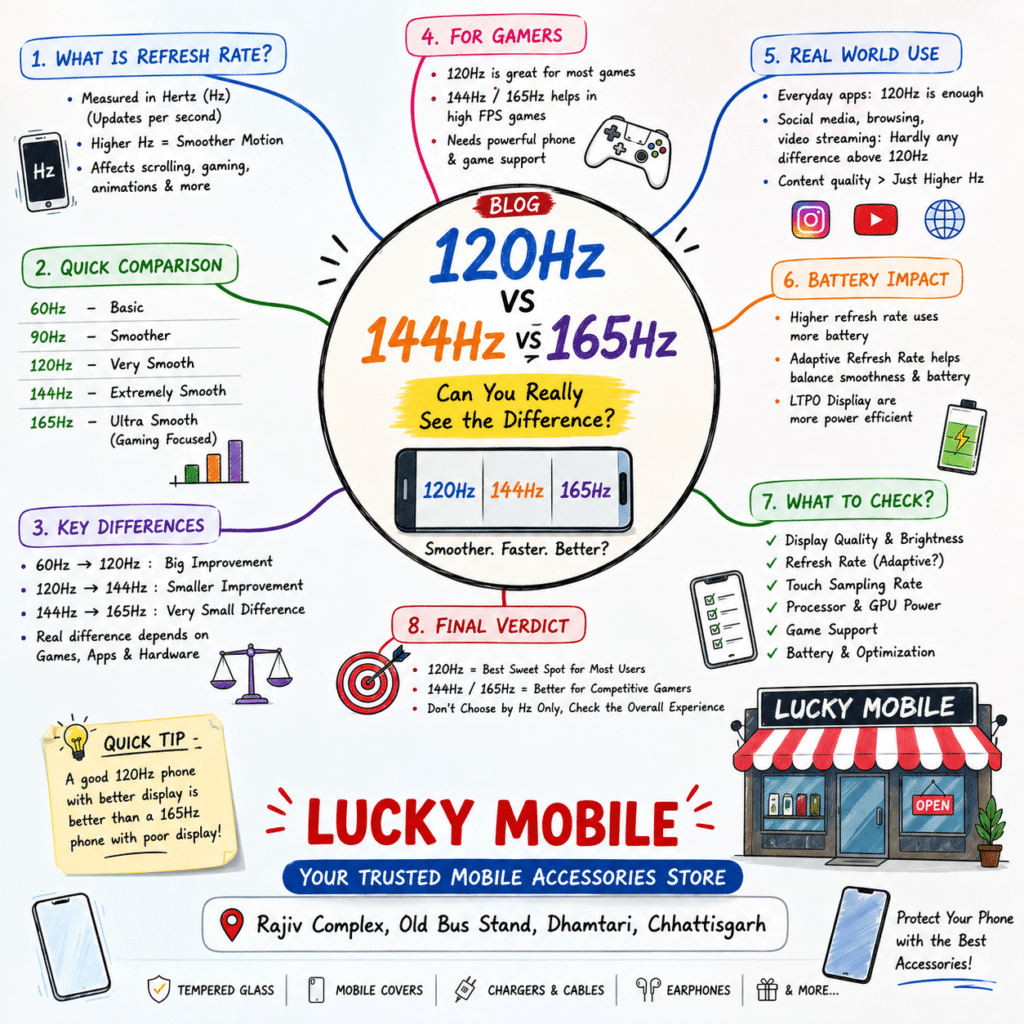
120Hz vs 144Hz vs 165Hz: Can You Really See the Difference?
You are shopping for a new smartphone and you see the display specification:
120Hz
Then another phone says:
144Hz
And a gaming phone advertises:
165Hz
It sounds like the 165Hz phone must be dramatically better.
But is it?
The answer is more interesting than simply saying “higher is better.”
Refresh rate can make a smartphone feel smoother, particularly while scrolling, navigating the interface and playing games that support higher frame rates. But the jump from 120Hz to 144Hz or 165Hz is much smaller than the jump from 60Hz to 120Hz, and many everyday apps do not continuously use the highest available refresh rate.
So, is 165Hz worth paying more for?
Let’s break it down.
What Is Smartphone Refresh Rate?
Refresh rate is measured in Hertz (Hz).
It tells you how many times the screen can update the image every second.
For example:
60Hz = up to 60 updates per second
90Hz = up to 90 updates per second
120Hz = up to 120 updates per second
144Hz = up to 144 updates per second
165Hz = up to 165 updates per second
A higher refresh rate can make motion look smoother.
You notice it most when:
- Scrolling through websites
- Moving through social media
- Swiping between screens
- Playing compatible games
- Watching fast-moving content
- Navigating animations
Samsung describes refresh rate as the number of times the display updates the image each second and recommends 120Hz for a smooth gaming experience.
60Hz vs 90Hz vs 120Hz vs 144Hz vs 165Hz
Before comparing 120Hz, 144Hz and 165Hz, it helps to understand the whole range.
| Refresh Rate | General Experience | Best For |
|---|---|---|
| 60Hz | Basic | Calls, messaging, simple use |
| 90Hz | Smoother | Everyday use, social media |
| 120Hz | Very smooth | Most users, gaming, scrolling |
| 144Hz | Extremely smooth | Gaming-focused users |
| 165Hz | Very high refresh | Select gaming scenarios |
These are general categories.
The actual experience depends on the phone, processor, software, display panel, game support and battery management.
120Hz vs 144Hz: What’s the Difference?
The difference exists, but for most people it is relatively small.
A 144Hz screen can update more frequently than a 120Hz screen.
But you have to remember something important:
Your phone has to produce content fast enough to take advantage of it.
If an application or game is running at 60fps, a 144Hz screen does not magically turn that content into 144fps.
This is one of the biggest misconceptions about refresh rate.
144Hz vs 165Hz: Can You Notice It?
The difference between 144Hz and 165Hz is even smaller.
On paper:
165Hz > 144Hz
But in normal activities such as:
- Web browsing
- Reading
- Typing
most people are unlikely to see a dramatic difference.
Recent smartphone analysis has found that many everyday apps and interfaces do not fully use refresh rates above 120Hz, which limits the practical advantage of 144Hz and 165Hz for ordinary users.
Why Is 120Hz Such a Popular Sweet Spot?
This is where things get interesting.
A good 120Hz smartphone display already feels extremely smooth.
The difference between:
60Hz → 120Hz
is much more obvious than:
120Hz → 144Hz
and:
144Hz → 165Hz
That is why 120Hz has become an important target for many smartphone buyers.
It gives you a strong combination of:
Smoothness + responsiveness + reasonable power management + broad app support
For everyday smartphone users, that combination is hard to beat.
How Much Smoother Is 120Hz Than 60Hz?
Quite noticeably smoother.
When scrolling a webpage on a 60Hz display, the screen updates 60 times per second.
At 120Hz, the potential update frequency doubles.
This can make:
- Text movement look clearer
- Scrolling feel more fluid
- Animations feel more responsive
- UI transitions look smoother
The difference is often immediately noticeable when you switch between a 60Hz and 120Hz phone. Recent smartphone display explainers similarly identify 120Hz as a major smoothness upgrade over 60Hz.
120Hz vs 144Hz: Which Is Better for Gaming?
This depends on the game.
If a game supports only:
60fps
then there is little reason to buy a 144Hz display specifically for that game.
If the game supports:
120fps
then a 120Hz display can already take advantage of it.
If a particular game genuinely supports frame rates beyond 120fps and your smartphone hardware can maintain them, 144Hz or 165Hz can provide additional headroom.
But this is a much narrower scenario.
That is why high-refresh-rate gaming phones can benefit from 144Hz or 165Hz, while a normal smartphone user may not notice much difference.
FPS and Refresh Rate Are Not the Same
This is extremely important.
Refresh rate = what the display can show
Frame rate (FPS) = what the phone/game actually produces
Imagine you have:
165Hz display + game running at 60fps
The display is capable of 165 updates per second.
But the game is only producing 60 frames per second.
Therefore, the complete experience is still limited by what the game is producing.
That’s why buying the phone with the biggest Hz number is not automatically the best choice.
Does a 165Hz Display Make a Phone Faster?
No.
A high refresh rate does not automatically make your processor faster.
It doesn’t automatically increase:
- CPU performance
- GPU performance
- RAM
- Storage speed
- Camera quality
- Network speed
It mainly affects how smoothly supported visual content is displayed.
So don’t confuse:
165Hz display
with:
165Hz = faster smartphone
They are different things.
Does Higher Refresh Rate Use More Battery?
Potentially, yes.
Running a display at a higher refresh rate can require more power than using a lower refresh rate, although actual consumption depends on the display technology, brightness, software and adaptive refresh-rate implementation.
That’s why many smartphones now use adaptive refresh rates.
The phone can change the refresh rate depending on what you’re doing.
For example:
Scrolling → higher refresh rate
Reading static text → lower refresh rate
This can help balance smoothness and battery life.
What Is Adaptive Refresh Rate?
An adaptive display doesn’t necessarily stay at its maximum refresh rate all day.
Instead, the phone dynamically changes it.
This is useful because not everything needs 120Hz, 144Hz or 165Hz.
Imagine you’re reading an article.
There is very little movement.
Keeping the display at its maximum refresh rate may provide little visible benefit.
But when you start scrolling, a higher refresh rate can make the movement smoother.
Adaptive refresh-rate systems are therefore an important feature to consider alongside the headline maximum refresh rate.
What Is LTPO?
You may also see smartphones advertised with:
LTPO AMOLED
LTPO is a technology that can support variable refresh-rate operation.
It’s commonly associated with premium smartphones because it can help the display change refresh rate depending on the content.
That can help deliver:
Smoothness when you need it + lower power use when you don’t.
So when comparing two premium phones, an LTPO display can sometimes be more meaningful than simply comparing:
120Hz vs 144Hz
120Hz vs 144Hz vs 165Hz for Normal Users
Let’s make this simple.
For WhatsApp
120Hz is already excellent.
You probably won’t gain much from 144Hz or 165Hz.
For Instagram
120Hz is more than enough for most people.
Scrolling will feel smooth.
For YouTube and Netflix
Refresh rate isn’t the biggest factor.
Video content itself is commonly produced at frame rates such as 24fps, 30fps or 60fps, so a 165Hz screen doesn’t automatically make normal video content 165fps.
For browsing
120Hz is excellent.
For gaming
120Hz is a strong option.
144Hz or 165Hz becomes more interesting for specific gaming scenarios where the game and hardware genuinely support higher frame rates.
120Hz vs 144Hz vs 165Hz for Gamers
| Feature | 120Hz | 144Hz | 165Hz |
|---|---|---|---|
| Smooth scrolling | Excellent | Excellent | Excellent |
| Everyday use | Excellent | Excellent | Excellent |
| Gaming | Excellent | Excellent | Excellent |
| Competitive gaming | Very good | Excellent | Excellent |
| Extra headroom above 120fps | No | Yes | Yes |
| Difference from 120Hz | — | Small | Small |
| Battery considerations | Moderate | Higher potential | Higher potential |
| Best audience | Most users | Gaming enthusiasts | Serious/high-refresh gaming users |
The biggest point is:
The higher number matters most when the rest of the system can actually use it.
Touch Sampling Rate Is Also Important
Gamers sometimes focus completely on refresh rate.
But touch sampling matters too.
Touch sampling rate relates to how frequently the touchscreen can detect touch input.
So for gaming, you should consider:
Refresh rate + touch response + processor + GPU + game optimization
A 165Hz display with poor touch responsiveness is not automatically a better gaming experience than a well-optimized 120Hz phone.
What About 240Hz Smartphone Displays?
Some gaming-oriented devices can push smartphone display refresh rates even higher.
But once you move far beyond 120Hz, the practical advantage becomes increasingly specialized.
For most users, it makes more sense to invest in:
A better display panel
rather than chasing the biggest refresh-rate number.
A bright, accurate 120Hz display can be a better everyday experience than a mediocre 165Hz display.
Is 165Hz Worth Paying More For?
For most people:
Probably not solely because of the refresh rate.
If the 165Hz smartphone also gives you:
- Better processor
- Better display brightness
- Better cooling
- Better battery
- Better cameras
- Better speakers
- Better build quality
then the overall phone may be worth buying.
But paying substantially more only to move from 120Hz to 165Hz isn’t necessary for most users.
Recent reporting similarly concludes that 144Hz and 165Hz provide relatively limited gains in typical smartphone use compared with a well-optimized 120Hz display.
What Is the Best Refresh Rate for a Smartphone?
For most people:
120Hz is the sweet spot.
It provides a very smooth experience without making you chase an extremely high specification.
60Hz
Good for basic use and budget phones.
90Hz
A noticeable improvement over 60Hz.
120Hz
Excellent for everyday use and gaming.
144Hz
Interesting for gaming enthusiasts.
165Hz
Most useful for specialized high-refresh gaming scenarios.
What Should You Check Before Buying a High-Refresh-Rate Phone?
Don’t look at Hz alone.
Check:
1. Display Brightness
This matters enormously outdoors.
2. Panel Type
AMOLED, OLED or LCD can affect the overall viewing experience.
3. Adaptive Refresh Rate
A phone that intelligently adjusts refresh rate can offer a better balance.
4. Touch Response
Important for gaming.
5. Processor and GPU
The phone needs enough performance to produce high frame rates.
6. Game Support
The game must actually support higher frame rates.
7. Battery
High refresh rates can affect power consumption.
8. Software Optimization
The operating system and apps need to make good use of the display.
120Hz vs 144Hz vs 165Hz: The Real-World Verdict
Here’s the simple answer:
60Hz → 120Hz: Big improvement
90Hz → 120Hz: Noticeable improvement
120Hz → 144Hz: Smaller improvement
144Hz → 165Hz: Even smaller improvement
That doesn’t mean 144Hz or 165Hz are useless.
It means their value depends heavily on the type of user you are.
For normal smartphone use, a good 120Hz display is already extremely smooth.
For competitive mobile gaming, higher refresh rates can make sense when the game and hardware support them.
⭐ Lucky Mobile Dhamtari – Our Smartphone Buying Tip
When you’re comparing smartphones at a mobile shop in Dhamtari, don’t choose a phone only because it says 144Hz or 165Hz on the box.
Hold the phones side by side.
Open the same app.
Scroll through a webpage.
Watch a video.
Try a game.
Then compare the overall experience.
Check the:
Display quality + brightness + smoothness + touch response + battery + processor
A good 120Hz phone can be a smarter purchase than a phone with a higher refresh-rate number but weaker overall specifications.
If you’re looking for a mobile store in Dhamtari or mobile accessories in Dhamtari, you can also visit Lucky Mobile for accessories to protect your new smartphone.
Lucky Mobile
Rajiv Complex, Old Bus Stand, Dhamtari, Chhattisgarh
Your Trusted Mobile Accessories Store
⭐ Lucky Mobile Dhamtari FAQ
Where is Lucky Mobile located in Dhamtari?
Lucky Mobile is located at Rajiv Complex, Old Bus Stand, Dhamtari, Chhattisgarh.
Can I buy tempered glass for my new smartphone at Lucky Mobile?
Yes, you can visit Lucky Mobile to check available tempered glass and screen protection options for different smartphone models.
Does Lucky Mobile sell mobile covers?
Yes, Lucky Mobile offers mobile covers for different smartphone models, subject to availability.
Can I buy chargers and data cables at Lucky Mobile Dhamtari?
Yes, you can visit Lucky Mobile to check available chargers and data cables for compatible smartphones.
Can Lucky Mobile help me choose accessories for a new 120Hz or 144Hz phone?
Yes. Tell us your exact smartphone model and we can help you choose suitable accessories such as a cover, tempered glass, charger or cable.
sUGGESTED ARTICLES
- AMOLED vs OLED vs LCD
- Tempered Glass
- Mobile Covers
- Mobile Chargers & Adaptors
- Data Cables
- Power Banks
- Fast Charging vs Battery Health
- Original vs Duplicate Mobile Accessories
Suggested Amazon Affiliate Products
1. 120Hz AMOLED Smartphone
2. Gaming Smartphone With High Refresh Rate
3. Tempered Glass
4. Gaming-Friendly Mobile Cover
5. Fast USB-C Charger
6. High-Quality USB-C Cable
Affiliate Disclosure
This article may contain affiliate links. If you purchase a product through these links, Lucky Mobile may earn a small commission at no additional cost to you.
Always check the latest specifications, compatibility and seller information before purchasing.
Final Verdict
120Hz vs 144Hz vs 165Hz isn’t really a battle of “higher number wins.”
For most smartphone users, 120Hz is the sweet spot.
It is smooth enough for everyday scrolling, apps, social media and most gaming.
144Hz and 165Hz can make sense when you’re specifically interested in high-refresh-rate gaming and the smartphone, game and hardware can actually take advantage of the extra refresh rate.
So when buying your next smartphone, don’t ask only:
“How many Hz does it have?”
Ask:
“How good is the entire display?”
Check the refresh rate, brightness, panel technology, touch response, adaptive refresh rate and overall phone performance.
And if you’re buying a new smartphone in Dhamtari, don’t forget to protect that display with the right tempered glass and mobile cover.
Smooth Screen. Smart Choice. Better Protection.
Lucky Mobile Dhamtari
Rajiv Complex, Old Bus Stand, Dhamtari, Chhattisgarh
Your Trusted Mobile Accessories Store