
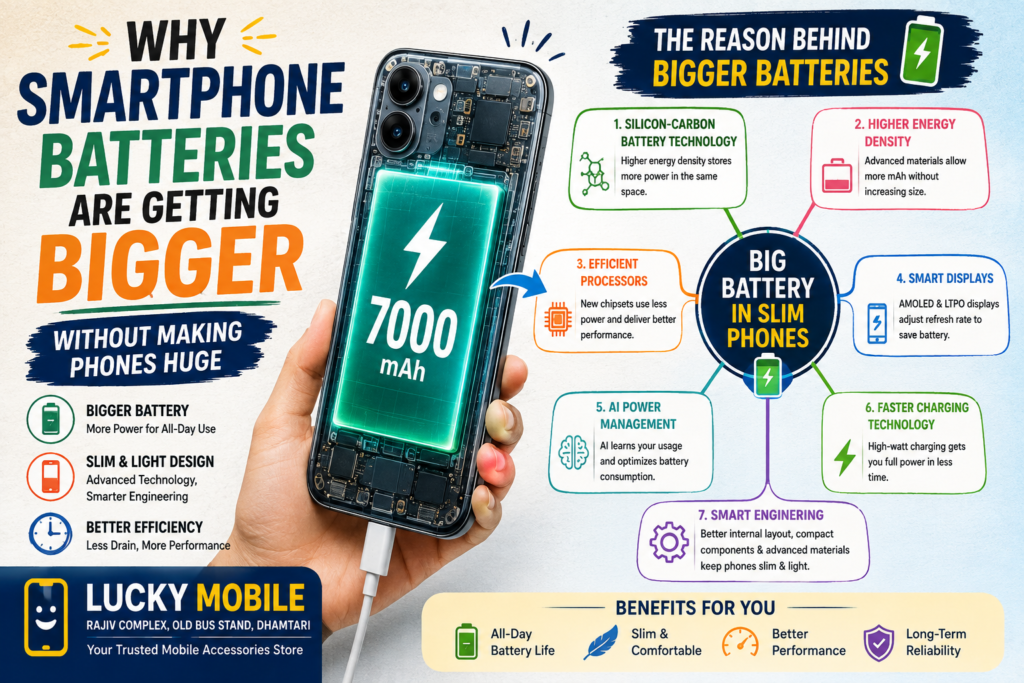
Why Smartphone Batteries Are Getting Bigger Without Making Phones Huge
Remember when a smartphone with a 4,000mAh or 5,000mAh battery was considered to have a good battery?
Today, smartphone manufacturers are pushing battery capacities much higher.
We are seeing phones with 6,000mAh, 7,000mAh and even larger batteries while manufacturers are still trying to keep their phones reasonably slim and comfortable to hold.
So, how is this possible?
Are smartphone batteries becoming physically smaller?
Is silicon-carbon technology responsible?
And does a bigger battery automatically mean better battery life?
The answer is a little more complicated.
Modern smartphone battery technology is improving because manufacturers are working on several things at the same time — battery chemistry, energy density, processor efficiency, display technology, charging systems and software optimisation.
Let’s understand what is happening inside modern smartphones.
Why Are Smartphone Batteries Getting Bigger?
Smartphones are doing more work than ever before.
A modern phone can be used for:
- 5G connectivity
- Gaming
- Video recording
- Streaming
- Navigation
- Social media
- Video calls
- AI features
- Photography
- Hotspot usage
- Online payments
- Productivity
- Background applications
All of these activities consume energy.
At the same time, users expect their phones to last throughout the day without constantly searching for a charger.
This creates a simple challenge for manufacturers:
More performance + more features + longer battery life
One solution is to increase battery capacity.
But simply making a battery bigger can make a smartphone thicker and heavier.
That is where newer battery technology becomes important.
From 4,000mAh to 7,000mAh and Beyond
For many years, smartphone battery capacity gradually increased.
The industry moved from batteries around 3,000mAh to 4,000mAh and then to 5,000mAh.
Now, higher-capacity batteries are becoming much more common.
But there is an important point:
mAh is not the complete story.
mAh stands for milliampere-hour and describes electrical charge capacity.
The actual amount of energy stored also depends on voltage.
That means two batteries with the same mAh rating don’t necessarily contain exactly the same amount of energy.
For smartphone buyers, however, mAh remains a useful specification for comparing phones within similar battery technologies and designs.
The Big Change: Battery Energy Density
One of the most important concepts behind modern battery development is energy density.
Energy density describes how much energy a battery can store relative to its size or weight.
Imagine two batteries that occupy almost the same amount of space.
If one stores more energy than the other, it has a higher energy density.
This is extremely important for smartphones.
Manufacturers don’t simply want:
A bigger battery.
They want:
More energy stored in the same amount of space.
This allows manufacturers to increase battery capacity without making the phone dramatically larger.
Silicon-Carbon Batteries Are Changing the Game
One of the technologies helping manufacturers achieve higher energy density is the silicon-carbon battery.
A silicon-carbon battery is still part of the lithium-ion battery family, but silicon-based material is used in the anode along with carbon-based materials.
Silicon has a much higher theoretical capacity for storing lithium than conventional graphite.
The challenge is that silicon expands considerably when it absorbs lithium.
Battery manufacturers therefore need sophisticated engineering to manage this expansion and maintain durability.
The result is a technology that can potentially provide greater energy storage in a compact package.
This is one reason silicon-carbon batteries have become increasingly common in newer smartphones.
How Can a Phone Have a 7,000mAh Battery and Still Be Slim?
This is where several engineering improvements come together.
A manufacturer can optimise:
- Battery chemistry
- Battery shape
- Internal components
- Motherboard layout
- Cooling system
- Processor efficiency
- Display technology
- Software
- Charging circuitry
Instead of simply increasing the physical size of the battery, engineers try to make better use of the available internal space.
Smartphone design is essentially a giant exercise in space management.
The battery, cameras, motherboard, speakers, antennas, cooling components and other parts all have to fit inside the phone.
Every millimetre matters.
Bigger Battery Doesn’t Always Mean Heavier Phone
It sounds logical that a bigger battery should make a phone much heavier.
But smartphone manufacturers are constantly working on materials and internal construction.
They can use:
- More compact components
- Advanced battery designs
- Different frame materials
- Optimised motherboard layouts
- Smaller supporting components
The final weight still depends on the complete phone design.
A large battery can contribute to higher weight, but it doesn’t tell you exactly how heavy a smartphone will be.
This is why you should always check the phone’s actual dimensions and weight rather than judging it only from the battery capacity.
Processor Efficiency Also Matters
Battery capacity is only one side of the equation.
The other side is how efficiently the smartphone uses that energy.
Modern smartphone processors are designed to deliver high performance while controlling power consumption.
A processor may have:
- High-performance cores
- Efficiency cores
- Advanced manufacturing technology
- Integrated graphics
- AI processing hardware
- Intelligent power management
When the phone is performing a simple task, it doesn’t always need maximum processing power.
The system can adjust performance depending on what you are doing.
For example:
Reading a message requires relatively little processing.
Gaming requires significantly more.
Good power management helps the phone use energy according to the workload.
Display Technology Is Also Important
The display is one of the biggest consumers of smartphone power.
Modern phones increasingly use technologies such as:
- AMOLED
- OLED
- LTPO
- Adaptive refresh rates
An adaptive refresh-rate display can adjust its refresh rate according to the activity.
For example, a phone may use a high refresh rate during gaming or scrolling and reduce it when displaying static content.
This can help balance smoothness and power consumption.
So two phones with identical battery capacities can still deliver different battery life because their displays and software use power differently.
Does 120Hz Use More Battery?
Generally, a higher refresh rate can consume more power than a lower refresh rate.
However, modern displays can intelligently adjust their refresh rate.
This is why technologies such as LTPO and adaptive refresh rates are becoming important.
Instead of keeping the display at the highest refresh rate all the time, the phone can dynamically adjust it.
The actual battery impact depends on the display technology, brightness, software and what you are doing on the phone.
Does 5G Drain the Battery?
5G can consume additional power depending on network conditions and how the phone is being used.
When the signal is weak, the phone may work harder to maintain connectivity.
Activities such as:
- 5G streaming
- Large downloads
- Hotspot use
- Online gaming
- Video calls
can increase battery consumption.
Modern chipsets and modems are becoming more efficient, but network conditions still have a major effect on battery life.
This is another reason why real-world battery performance can differ from laboratory specifications.
AI Is Also Changing Battery Management
AI is becoming a bigger part of smartphones.
But AI isn’t only being used for cameras and voice assistants.
It can also help with power management.
Depending on the smartphone and software, intelligent systems can learn patterns such as:
- Which apps you use frequently
- Which apps you rarely open
- When you normally charge your phone
- How you use your device during the day
The phone can then make power-management decisions based on usage patterns.
The goal is simple:
Use energy where you need it and avoid wasting it where you don’t.
Bigger Battery vs Faster Charging
A larger battery solves one problem:
More stored energy.
Fast charging solves another:
Less waiting when the battery is low.
Modern smartphones are increasingly combining both.
For example, a phone may have a large-capacity battery and a high-speed charging system.
This means you can get long battery endurance while also being able to recharge relatively quickly.
But fast charging depends on more than the advertised wattage.
You also need:
- Compatible charger
- Compatible cable
- Supported charging protocol
- Suitable charging temperature
- Proper charging circuitry
A 100W charger does not mean every phone connected to it will charge at 100W.
Why Charger Quality Still Matters
When smartphone batteries become larger and charging speeds become faster, choosing the correct charger becomes even more important.
A charger should be compatible with the phone’s supported charging technology.
Look for:
- Correct wattage
- USB-C support
- Appropriate charging protocol
- Safety protections
- Good-quality construction
The same applies to USB-C cables.
A USB-C connector tells you the shape of the connector.
It does not automatically tell you the maximum charging power or data speed of the cable.
This is why a good-quality cable is an important part of the charging setup.
Does a Bigger Battery Mean Two Days of Battery Life?
Not necessarily.
This is probably the biggest misunderstanding about smartphone batteries.
Battery life depends on the entire system.
For example:
| Factor | Effect on Battery Life |
|---|---|
| Battery capacity | Determines available energy |
| Processor | Determines processing efficiency |
| Display | Major power consumer |
| Refresh rate | Can affect display power consumption |
| Brightness | Higher brightness generally uses more power |
| 5G | Can increase consumption depending on usage and signal |
| Gaming | High power consumption |
| Camera | Can consume significant power during heavy use |
| Software | Controls background and system power management |
| Temperature | Can affect battery performance |
A 7,000mAh smartphone isn’t automatically twice as good as a 3,500mAh phone.
The complete hardware and software system matters.
Why Gamers Benefit From Bigger Batteries
Mobile gaming can put significant pressure on a smartphone.
During gaming, the phone may simultaneously use:
- CPU
- GPU
- Display
- Network
- Speakers
- Cooling system
A larger battery can provide more energy for extended gaming sessions.
However, battery capacity isn’t the only factor.
Gamers should also look at:
- Processor performance
- GPU
- Cooling
- Display refresh rate
- Touch sampling
- Network performance
- Sustained performance
A huge battery cannot compensate for poor thermal management or an inefficient processor.
Who Actually Needs a Big-Battery Smartphone?
A large battery can be particularly useful for people who spend long periods away from a charger.
Students
For online classes, social media, videos and communication throughout the day.
Business Users
For calls, messaging, navigation and productivity.
Travellers
For GPS, photography, entertainment and communication.
Content Creators
For camera usage, video recording and editing.
Gamers
For longer gaming sessions.
Outdoor Workers
For people who may not have regular access to charging.
What Should You Check Before Buying a Big-Battery Phone?
Don’t stop at the mAh number.
Use this checklist:
1. Battery Capacity
Check the advertised battery capacity.
2. Battery Technology
Check whether the phone uses conventional lithium-ion or a newer silicon-carbon design.
3. Processor
Look for efficiency as well as performance.
4. Display
Check AMOLED/OLED, refresh rate and adaptive refresh technology.
5. Charging
Check charging speed and supported standards.
6. Charger
Check whether a compatible charger is included.
7. Weight
A bigger battery can affect the overall weight.
8. Thickness
Compare the actual dimensions of the phone.
9. Software
Good software optimisation can significantly affect battery endurance.
10. After-Sales Support
Battery replacement and service availability are also important when planning to keep a phone for several years.
Silicon-Carbon vs Traditional Battery Technology
| Feature | Traditional Lithium-Ion | Silicon-Carbon |
|---|---|---|
| Main battery family | Lithium-ion | Lithium-ion |
| Common anode material | Graphite | Silicon + carbon-based materials |
| Energy-density potential | Lower | Higher |
| Large capacity potential | More limited | Greater |
| Smartphone use | Very widespread | Increasing rapidly |
| Engineering challenge | Mature technology | Silicon expansion and durability |
| Main attraction | Proven technology | More energy in compact designs |
Silicon-carbon technology isn’t about replacing lithium-ion completely.
It is about improving the materials used within lithium-ion battery systems to achieve greater energy-storage potential.
Is a Bigger Battery Always Better?
No.
It depends on your priorities.
If you are a heavy user, a large battery can be extremely useful.
But if you mainly use your phone for calls, WhatsApp, browsing and occasional videos, you may not need the biggest battery available.
A phone with a smaller battery can still provide excellent battery life if it has:
- Efficient hardware
- Good software
- Efficient display
- Strong battery management
The best smartphone is not necessarily the one with the biggest battery.
It is the one that provides the right balance for your usage.
⭐ Lucky Mobile Dhamtari Buying Tip
At Lucky Mobile, we believe customers should choose smartphones based on how they actually use them.
Before buying a phone, ask yourself:
How many hours do I use my phone every day?
Do I play games?
Do I use 5G frequently?
Do I travel a lot?
Do I use the camera heavily?
Do I need fast charging?
Do I want a slim and lightweight phone?
Your answers can help determine whether you should prioritise battery capacity, charging speed, processor efficiency, camera performance or overall design.
A smartphone with a massive battery isn’t automatically the right choice for everyone.
⭐ Lucky Mobile Dhamtari FAQ
⭐ Can I buy big-battery smartphones at Lucky Mobile Dhamtari?
Smartphone models and availability can change. Visit Lucky Mobile and ask about the latest big-battery smartphones available for your requirements.
⭐ Can Lucky Mobile help me choose a smartphone with good battery life?
Yes. Tell us how you use your phone, your preferred features and your budget, and we can help you compare suitable smartphones.
⭐ Does Lucky Mobile sell chargers for big-battery smartphones?
Yes. Lucky Mobile offers mobile accessories including chargers and USB-C cables. Charger compatibility should always be checked according to the smartphone model.
⭐ Can I buy a power bank from Lucky Mobile Dhamtari?
Yes. Power banks are among the mobile accessories available at Lucky Mobile. You can choose one according to your phone and usage requirements.
⭐ Does Lucky Mobile sell USB-C cables?
Yes. Lucky Mobile offers USB-C cables and other mobile accessories. Tell us your smartphone model and charging requirement so the appropriate cable can be selected.
⭐ Can Lucky Mobile help me choose a mobile cover for a new phone?
Yes. You can bring the exact smartphone model to the store and check suitable mobile-cover options.
⭐ Can I get tempered glass for a new smartphone at Lucky Mobile?
Yes. Lucky Mobile provides tempered-glass options for different smartphone models, subject to availability.
⭐ Where is Lucky Mobile Dhamtari located?
Lucky Mobile is located at:
Rajiv Complex, Old Bus Stand, Dhamtari, Chhattisgarh.
📍 Visit Lucky Mobile Dhamtari
LUCKY MOBILE
Rajiv Complex,
Old Bus Stand,
Dhamtari, Chhattisgarh.
Whether you are looking for a new smartphone or accessories such as tempered glass, mobile covers, chargers, USB-C cables, power banks and other mobile accessories, Lucky Mobile can help you find suitable options.
Final Thoughts
Smartphone batteries are getting bigger, but the story isn’t simply about adding more mAh.
The real change is happening inside the phone.
Better battery materials are helping manufacturers store more energy.
More efficient processors are reducing unnecessary power consumption.
Modern displays can intelligently manage refresh rates.
Software can optimise background activity.
AI can help phones manage certain tasks more intelligently.
Fast-charging technology can reduce the amount of time you spend connected to a charger.
Together, these technologies are changing what we expect from smartphone battery life.
So the next time you see a smartphone with a 7,000mAh or larger battery, don’t just ask:
“How big is the battery?”
Also ask:
“How efficiently does the phone use it?”
Because the future of smartphone battery life isn’t only about bigger batteries.
It is about more energy, better efficiency and smarter power management.
For smartphones and mobile accessories in Dhamtari, visit Lucky Mobile, Rajiv Complex, Old Bus Stand, Dhamtari.
AFFILIATE DISCLOSURE
Some links in this article may be affiliate links. If you purchase a product through an affiliate link, Lucky Mobile may earn a commission at no additional cost to you. This helps support our website.
SUGGESTED BLOGS
Blog → How to Choose the Right Mobile Charger
Blog → USB Type-C Explained: Charging, Data and Compatibility
Blog → 7 Must-Have Mobile Accessories for Your New Smartphone
Blog → AI Phones in 2026: What Can Your Smartphone Actually Do With AI