
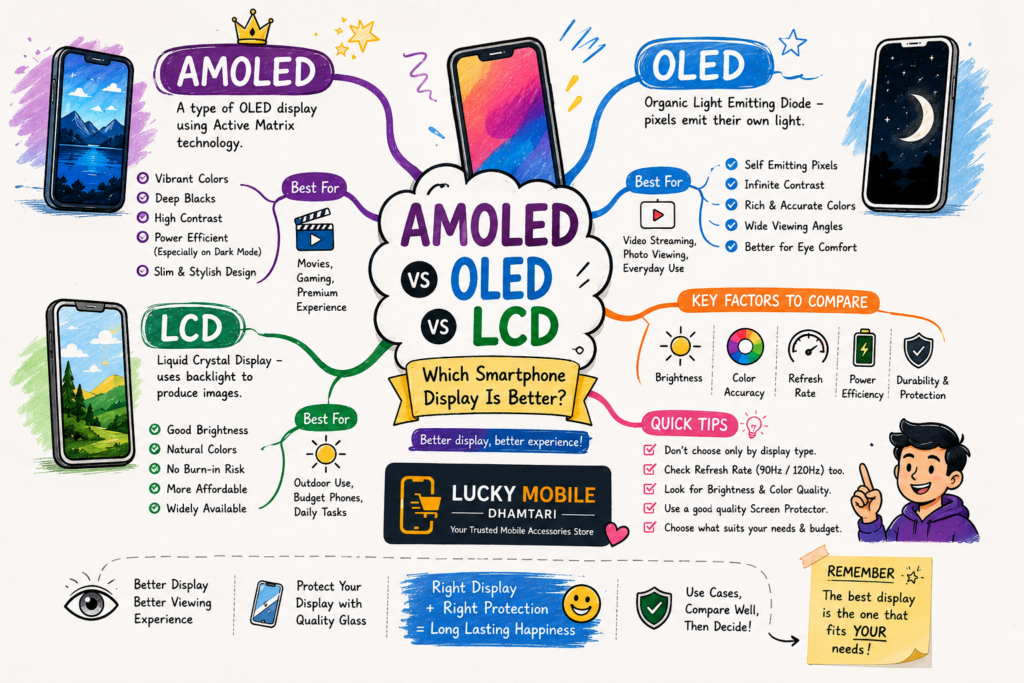
AMOLED vs OLED vs LCD: Which Smartphone Display Is Better?
The display is one of the first things you notice when you use a smartphone.
Whether you are watching YouTube, scrolling through Instagram, playing games, reading messages or looking at photos, the screen affects your everyday experience.
But smartphone displays come with different names such as LCD, OLED and AMOLED.
So what is the difference?
Is AMOLED better than OLED? Is LCD still good? And does a better display always mean a better smartphone?
In this guide, Lucky Mobile, Dhamtari, explains the differences between AMOLED, OLED and LCD displays in simple language.
What Is an LCD Display?
LCD stands for Liquid Crystal Display.
LCD screens use a backlight to illuminate the display. The pixels control how much light passes through to create different colours and images.
LCD technology has been used in smartphones for many years and is still found in many devices.
Advantages of LCD Displays
LCD displays can offer:
- Good brightness
- Natural-looking colours
- Reliable everyday performance
- Good readability
- Often lower manufacturing cost
LCD displays can still provide a good viewing experience, especially on smartphones designed for everyday use.
Limitations of LCD Displays
Because LCD displays require a backlight, black areas of the screen cannot usually become completely black in the same way that OLED-based displays can.
This can affect:
- Contrast
- Dark scenes
- Black levels
- Overall display appearance
What Is OLED?
OLED stands for Organic Light-Emitting Diode.
Unlike LCD, OLED pixels can produce their own light.
This means OLED displays do not require the same type of separate backlight used by LCD panels.
One major advantage is that individual pixels can be turned off when displaying black.
This can produce very deep blacks and high contrast.
Advantages of OLED
OLED displays can provide:
- Deep blacks
- High contrast
- Strong colours
- Slim display designs
- Excellent viewing experience
- Potential power advantages when displaying darker content
OLED technology is commonly used in premium smartphones and other modern displays.
What Is AMOLED?
AMOLED stands for Active Matrix Organic Light-Emitting Diode.
AMOLED is an OLED-based display technology that uses an active matrix to control individual pixels.
In simple terms:
OLED = Organic light-emitting display technology
AMOLED = A type of OLED display using active-matrix control
AMOLED displays are widely used in smartphones because they can offer strong contrast, deep blacks and vibrant images.
AMOLED vs OLED: Are They the Same?
AMOLED and OLED are closely related, but they are not exactly the same term.
OLED is the broader display technology.
AMOLED refers to a specific type of OLED display architecture.
For smartphone buyers, however, the exact display implementation and quality can matter more than simply seeing the word AMOLED or OLED in the specifications.
Other factors such as brightness, colour accuracy, refresh rate and calibration also affect the actual experience.
AMOLED vs OLED vs LCD
Here is a simple comparison:
LCD
Uses a backlight and liquid-crystal technology.
OLED
Uses self-emitting pixels that can turn off individually.
AMOLED
A type of OLED technology using an active-matrix system.
The exact display quality depends on the smartphone and its panel.
Which Display Has Better Black Levels?
OLED-based displays generally have an advantage when it comes to black levels.
Because individual pixels can turn off, a black area can appear very dark.
LCD displays use a backlight, so some light can still be present even when the screen is displaying black.
This is one reason OLED and AMOLED screens can look particularly impressive when watching movies or using dark themes.
Which Display Has Better Contrast?
OLED and AMOLED displays generally offer very high contrast because pixels can be turned off completely for black areas.
LCD displays can still provide good contrast, but they generally cannot achieve the same type of pixel-level black control.
For people who enjoy watching movies and videos, this can make OLED-based displays attractive.
Which Display Is Better for Watching Videos?
For many users, OLED or AMOLED can provide an excellent video experience.
The deep blacks and strong contrast can make movies, photos and videos look more immersive.
However, display quality is not determined by panel technology alone.
Brightness, resolution, colour accuracy, HDR support and calibration also matter.
Which Display Is Better for Gaming?
A good gaming display should be evaluated using several specifications.
Look at:
- Refresh rate
- Touch response
- Resolution
- Brightness
- Response time
- Colour quality
An AMOLED display with a high refresh rate can provide a smooth and responsive gaming experience.
However, an LCD display with a high refresh rate can also perform well.
The complete specification matters more than the display name alone.
What Is Refresh Rate?
Refresh rate tells you how many times the display can update the image per second.
It is measured in Hertz (Hz).
For example:
- 60Hz
- 90Hz
- 120Hz
- 144Hz
A higher refresh rate can make scrolling, animations and supported games appear smoother.
This is why you should consider refresh rate along with display technology.
Does AMOLED Save Battery?
AMOLED and other OLED-based displays can potentially use less power when displaying darker content because black pixels can be turned off.
However, actual battery consumption depends on many factors, including:
- Screen brightness
- Content being displayed
- Refresh rate
- Screen size
- Processor
- Software
- Battery capacity
So AMOLED does not automatically mean that every smartphone will have better battery life.
What About Screen Brightness?
Brightness is another important factor.
A smartphone with a high-quality display should be easy to view in different lighting conditions.
When comparing phones, look at the manufacturer’s brightness specifications and real-world reviews.
Don’t choose a smartphone only because it says AMOLED.
A good AMOLED display can still differ significantly from another AMOLED display.
What Is Burn-In?
OLED and AMOLED displays can be susceptible to image retention or burn-in under certain conditions.
Burn-in refers to persistent image elements that remain visible after displaying the same content for extended periods.
Modern smartphones use various software and hardware techniques to reduce this risk.
For normal everyday use, most users do not need to worry excessively about it, but it is still useful to understand the technology.
Does Display Quality Affect Touch Response?
Display technology and touch performance are related but not exactly the same thing.
Touch response can depend on the touchscreen hardware, software and device design.
If gaming is important to you, look for information about:
- Touch sampling
- Touch response
- Refresh rate
- Gaming optimisation
A high-quality display combined with responsive touch can make the smartphone feel much smoother.
AMOLED, OLED or LCD: Which One Should You Choose?
There is no single answer for everyone.
Choose AMOLED/OLED If You Want:
- Deep blacks
- High contrast
- Vibrant viewing
- Premium display experience
- Excellent movie and video viewing
LCD Can Be a Good Choice If You Want:
- Reliable everyday viewing
- Good brightness
- Natural-looking display
- A smartphone focused on practical use
The best choice depends on your budget and how you use your smartphone.
Some Smartphones With AMOLED Displays
If you are comparing smartphone displays, looking at real smartphones can make the difference easier to understand.
Here are some examples you can research:
Samsung Galaxy A56 5G
The Galaxy A56 5G is an example of a smartphone using an AMOLED-based display.
Realme 16 Pro 5G
The Realme 16 Pro 5G is another example of a smartphone featuring an AMOLED display.
Motorola Edge 70 Fusion
The Motorola Edge 70 Fusion is another smartphone example with an AMOLED display.
Before purchasing any smartphone, always check the exact model, variant and current specifications.
How to Choose a Smartphone Display
Don’t choose a phone only because it has AMOLED or OLED.
Check these specifications together:
Display Technology
Look for LCD, OLED, AMOLED or other display technology.
Refresh Rate
A higher refresh rate can make scrolling and animations smoother.
Brightness
Higher brightness can make the screen easier to see outdoors.
Resolution
Higher resolution can provide more detail, although screen size and viewing distance also matter.
Colour Accuracy
Good colour calibration can make photos and videos look more natural.
Touch Response
Gamers should pay attention to touch responsiveness and touch sampling.
Protection
Consider the type of screen protection used by the smartphone and use suitable tempered glass or screen protection.
What About Screen Protection?
Even a high-quality AMOLED or OLED display can be damaged by drops and scratches.
A suitable screen protector can help protect the display from everyday scratches and minor impacts.
When choosing tempered glass, make sure it is designed specifically for your smartphone model.
The quality of the glass also matters.
Look for features such as:
- Good clarity
- Smooth touch response
- Proper edge coverage
- Fingerprint-sensor compatibility where required
- Good adhesive
- Accurate fit
Where to Buy Smartphone Accessories in Dhamtari?
If you have purchased a new smartphone and need screen protection, cases, chargers or other accessories, you can visit Lucky Mobile in Dhamtari.
Choosing accessories according to the exact smartphone model is important because display size, edges, camera placement and fingerprint technology can differ between models.
Why Choose the Right Display?
Your smartphone display is something you interact with every day.
Whether you are reading, watching videos, taking photos or playing games, display quality can make a noticeable difference.
However, the best smartphone is not necessarily the one with the most impressive display specification.
Consider the complete package:
- Display
- Battery
- Processor
- Camera
- Storage
- Charging
- Software
- Build quality
- Price
Frequently Asked Questions
Is AMOLED better than LCD?
AMOLED can offer deeper blacks and higher contrast, but LCD displays can still provide a good viewing experience. The best choice depends on your requirements.
What is the difference between OLED and AMOLED?
OLED is the broader display technology, while AMOLED is a type of OLED display using an active-matrix system.
Is AMOLED good for gaming?
Yes. AMOLED displays can provide excellent contrast and vibrant visuals. For gaming, also check refresh rate and touch response.
Does AMOLED use less battery?
It can use less power when displaying darker content, but actual battery consumption depends on brightness, refresh rate, software and other factors.
Does AMOLED have better colours?
AMOLED displays can provide vibrant colours and strong contrast, but actual colour quality depends on the specific display and calibration.
Is LCD still good for smartphones?
Yes. A good LCD display can provide reliable brightness, colour and everyday viewing performance.
Can AMOLED screens get damaged?
Yes. AMOLED displays can be scratched or damaged by drops. A suitable screen protector and case can help protect the phone.
What is screen burn-in?
Screen burn-in is a persistent image or pattern that can remain visible on some OLED-based displays after prolonged exposure to static content.
Is a 120Hz AMOLED display better than a 60Hz LCD?
It depends on the phone and your priorities. A 120Hz display can provide smoother motion, while display technology, brightness and calibration also affect the overall experience.
Where can I buy screen protection in Dhamtari?
You can visit Lucky Mobile in Dhamtari for tempered glass, cases and other smartphone accessories.
Conclusion
AMOLED, OLED and LCD are different display technologies, and each has its own advantages.
OLED-based displays such as AMOLED can provide deep blacks, strong contrast and an excellent viewing experience. LCD displays can still offer good brightness and reliable everyday performance.
When choosing a smartphone, don’t look at the display technology alone.
Check refresh rate, brightness, resolution, colour quality, touch response and screen protection as well.
If you are buying a new smartphone, make sure you also choose the right case and screen protector for your exact model.
For smartphone accessories and screen protection in Dhamtari, visit Lucky Mobile.
Recommended Smartphones to Check
If you are comparing smartphones with AMOLED displays, you can also check the latest listings on Amazon.