
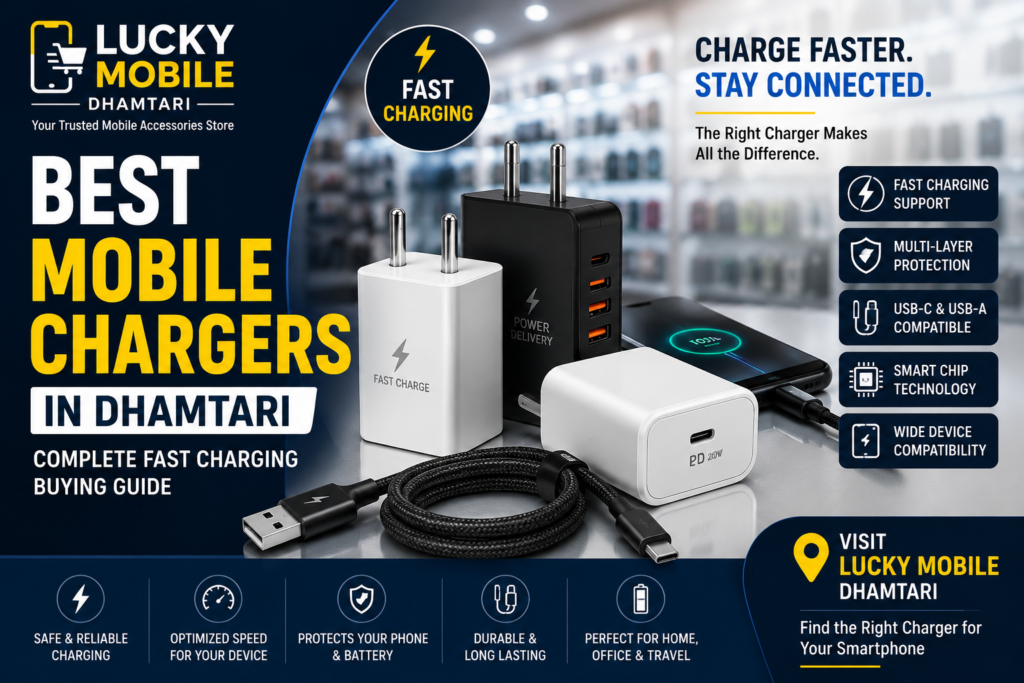
Choosing the right charger is important for your smartphone’s charging speed, battery performance and everyday convenience. A charger is not simply about plugging your phone into a power source. Different smartphones support different charging technologies, power levels and connector types.
If you are looking for mobile chargers in Dhamtari, it is important to choose a charger that matches your smartphone and charging requirements.
At Lucky Mobile, Dhamtari, customers can explore mobile charging accessories and choose suitable options according to their device.
Why Choosing the Right Mobile Charger Matters
Using a suitable charger helps you get the charging performance your smartphone is designed to support.
A good charger should offer:
- Compatible charging power
- Suitable charging technology
- Reliable build quality
- Proper connector compatibility
- Safety protection
- Stable power delivery
- Compatibility with your smartphone
The highest-wattage charger is not automatically the best charger for every phone. Your smartphone determines how much power it can accept.
What Does Charger Wattage Mean?
Charger power is commonly expressed in watts (W).
In simple terms:
Power = Voltage × Current
For example, a charger may provide different voltage and current combinations depending on the charging technology and connected device.
However, a phone does not necessarily draw the maximum wattage printed on the charger. The smartphone and charger communicate and regulate the charging power according to their supported standards.
That is why checking your phone’s charging specification is important.
Types of Mobile Chargers
1. Standard USB Charger
Standard chargers are designed for everyday charging and may be suitable for smartphones that do not support higher-speed charging.
They can be useful as a basic home, office or backup charger.
2. Fast Charger
Fast chargers are designed to provide higher charging power when supported by the smartphone.
The actual charging speed depends on several factors, including:
- Smartphone model
- Charger power
- Charging protocol
- Cable capability
- Battery condition
- Temperature
- Current battery percentage
A fast charger will not necessarily make every smartphone charge at the same speed.
3. USB-C Charger
USB-C has become a common connector for modern smartphones and accessories.
However, USB-C refers primarily to the connector type. It does not automatically mean that every USB-C charger provides the same charging speed or power.
Always check the charger’s supported specifications.
4. USB-C Power Delivery Charger
USB Power Delivery, commonly called USB PD, is a charging standard designed to negotiate suitable power between compatible devices and chargers.
It can support a range of power levels and is used across smartphones, tablets, laptops and other devices.
If your phone supports USB PD, a compatible PD charger can provide the charging performance supported by the device.
5. Multi-Port Charger
Multi-port chargers allow multiple devices to be connected to one charger.
They can be useful when charging:
- Smartphone
- Earbuds
- Smartwatch
- Tablet
- Other USB-powered accessories
Before using multiple ports simultaneously, check how the charger distributes its available power.
Fast Charging: What You Should Know
Fast charging technology allows compatible smartphones to charge more quickly than conventional charging methods.
However, charging speed is not determined by the charger alone.
Your:
Smartphone+Charger+Cable+Charging protocol=Actual charging performance
All four can affect the result.
For example, if your phone supports a particular fast-charging technology but the charger or cable does not support the required standard, the phone may charge at a lower rate.
Does a Higher-Watt Charger Charge Every Phone Faster?
No.
A smartphone generally draws only the power it is designed and configured to accept.
For example, connecting a phone that supports lower charging power to a higher-power compatible charger does not mean the phone will automatically use the charger’s maximum wattage.
Compatibility is more important than simply choosing the highest number.
Why the Charging Cable Matters
The charger is only one part of the charging system.
The cable can also affect charging performance.
A suitable cable should support the required:
- Connector type
- Current
- Charging standard
- Power level
- Data requirements, when applicable
For higher-power charging, use a cable that is appropriate for the charger’s and phone’s requirements.
USB-C to USB-C vs USB-A to USB-C
USB-C to USB-C
USB-C to USB-C cables are widely used with modern chargers and devices.
They are particularly useful with chargers that have USB-C output.
USB-A to USB-C
USB-A to USB-C cables can still be useful with chargers that have USB-A ports.
However, charging performance depends on the charger, cable and supported charging protocol.
Charger Safety Features Matter
A charger should be selected not only for charging speed but also for safety and reliability.
Quality chargers may include protection features such as:
- Over-voltage protection
- Over-current protection
- Short-circuit protection
- Over-temperature protection
- Power regulation
The exact protection features depend on the charger design.
Avoid choosing a charger solely because it is inexpensive or has a high wattage rating.
Original, Compatible and Low-Quality Chargers
When choosing a charger, focus on compatibility, specifications and build quality.
A reliable charger should clearly provide information about:
- Input specifications
- Output specifications
- Supported charging standards
- Power rating
- Manufacturer information
- Safety certifications where applicable
Very low-quality chargers may not provide the same level of electrical protection or consistent power delivery.
How to Choose the Right Charger for Your Phone
Step 1: Check Your Phone Model
First identify your exact smartphone model.
Different phones may support different charging technologies even if they use the same connector.
Step 2: Check Supported Charging Power
Check the manufacturer’s specifications for your phone’s supported charging power.
Do not choose a charger based only on its maximum wattage.
Step 3: Check the Charging Protocol
Your smartphone may support a particular charging standard or proprietary fast-charging technology.
Choose a charger that is compatible with the required standard.
Step 4: Choose the Correct Connector
Check whether your phone and charger require:
- USB-C
- USB-A
- Another compatible connection
Step 5: Choose the Right Cable
Make sure your cable supports the charging power and standard you want to use.
Step 6: Consider Your Usage
A compact single-port charger may be enough for everyday phone charging.
If you regularly charge multiple devices, a multi-port charger may be more convenient.
How to Choose a Charger for Multiple Devices
If you use several devices, a multi-port charger can reduce the number of adapters you need.
Before choosing one, check:
- Total output power
- Power distribution between ports
- USB-C support
- USB PD support
- Individual port output
- Compatibility with your devices
Remember that the available power may be divided when multiple devices are connected.
Common Mobile Charger Mistakes
Avoid these common mistakes:
- Buying only based on wattage
- Ignoring charging protocol compatibility
- Using a poor-quality cable
- Choosing an incompatible connector
- Ignoring charger safety specifications
- Assuming every USB-C charger is identical
- Using damaged cables
- Choosing an unknown charger without checking its specifications
How to Keep Your Charger and Cable Safe
Good charging habits can help extend the usable life of your accessories.
Keep Cables Away From Excessive Bending
Repeatedly bending a cable sharply near the connector can damage the internal wires.
Keep Charging Ports Clean
Dust and debris can interfere with proper connection.
Avoid Damaged Chargers
If a charger, plug or cable shows visible damage, stop using it and replace it with a suitable alternative.
Avoid Excessive Heat
Keep charging accessories away from unnecessary heat sources and ensure adequate ventilation around the charger.
Where to Buy Mobile Chargers in Dhamtari?
If you are searching for mobile chargers in Dhamtari, visit Lucky Mobile and check the available charging options for your smartphone.
Before choosing a charger, provide your exact phone model so the suitable charging power, connector and compatibility can be considered.
Lucky Mobile can help customers explore options for smartphones and other mobile devices based on their charging requirements.
Why Choose Lucky Mobile for Mobile Chargers?
At Lucky Mobile, Dhamtari, customers can explore mobile accessories and charging solutions for different smartphone models.
Instead of selecting a charger only by its wattage, consider the complete charging setup:
Phone+Charging Standard+Charger+Cable
Choosing compatible accessories can help you get the charging performance your device is designed to support.
Frequently Asked Questions
Which charger is best for a smartphone?
The best charger depends on your smartphone’s supported charging power, connector and charging protocol. Choose a reliable charger that matches your device specifications.
Is a higher-watt charger always better?
No. A higher-watt charger does not automatically make every phone charge faster. The smartphone determines how much power it can accept.
Does the charging cable affect charging speed?
Yes. The cable can affect charging performance, particularly when higher charging power or specific charging standards are involved.
Is USB-C the same as fast charging?
No. USB-C describes a connector type. Fast charging depends on the supported charging technology, power level and compatibility between the phone, charger and cable.
What is USB Power Delivery?
USB Power Delivery, or USB PD, is a charging standard that allows compatible devices and chargers to negotiate suitable power levels.
Can one charger charge multiple devices?
Yes, if it has multiple ports and sufficient power output. However, the available power may be distributed between connected devices.
How do I know which charger my phone needs?
Check your exact smartphone model and its manufacturer’s charging specifications. Then choose a charger and cable that support the required power and charging standard.
Where can I buy mobile chargers in Dhamtari?
You can visit Lucky Mobile in Dhamtari to explore available mobile chargers and charging accessories suitable for different smartphone models.
Conclusion
Choosing the right mobile charger is about more than selecting the highest wattage.
Your smartphone, charger, cable and charging protocol all work together to determine charging performance.
Before buying a charger, check your phone model, supported charging power, connector, charging standard and cable requirements.
If you are looking for mobile chargers in Dhamtari, visit Lucky Mobile and choose a charging solution that matches your smartphone and everyday requirements.